Compliance Aggregation for Saudi Holding Groups
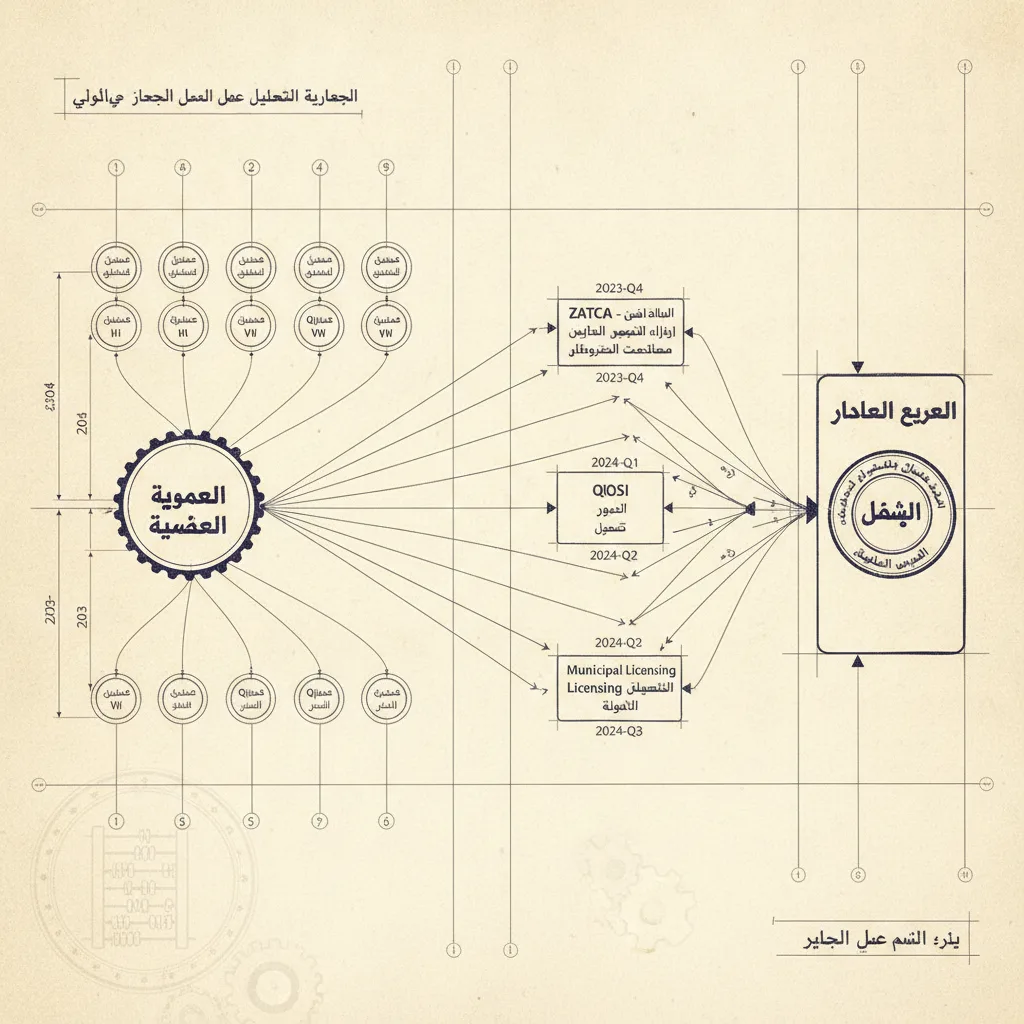
Eight operating subsidiaries. Four regulatory bodies. One compliance team trying to hold the line.
This is not an unusual configuration for a Saudi holding group — it is the standard one. And the standard configuration carries a structural problem that no amount of additional headcount fully resolves: the compliance surface does not grow linearly with the number of entities. It multiplies. Each subsidiary carries independent obligations to the Zakat, Tax and Customs Authority (ZATCA), the General Organization for Social Insurance (GOSI), the Qiwa labor platform, and the relevant municipal licensing authority. Each obligation runs on its own calendar. Each lapse is enforced against that specific legal entity. The group CFO sees none of this in aggregate unless someone has deliberately built a system to make it visible.
Most groups have not built that system. That omission is what this piece addresses.
Why Subsidiary-by-Subsidiary Tracking Fails at Scale
The instinctive response to a multi-entity compliance problem is to assign ownership: one person or team per subsidiary, each responsible for that entity's filings and notices. The logic is clean. The operational reality is not.
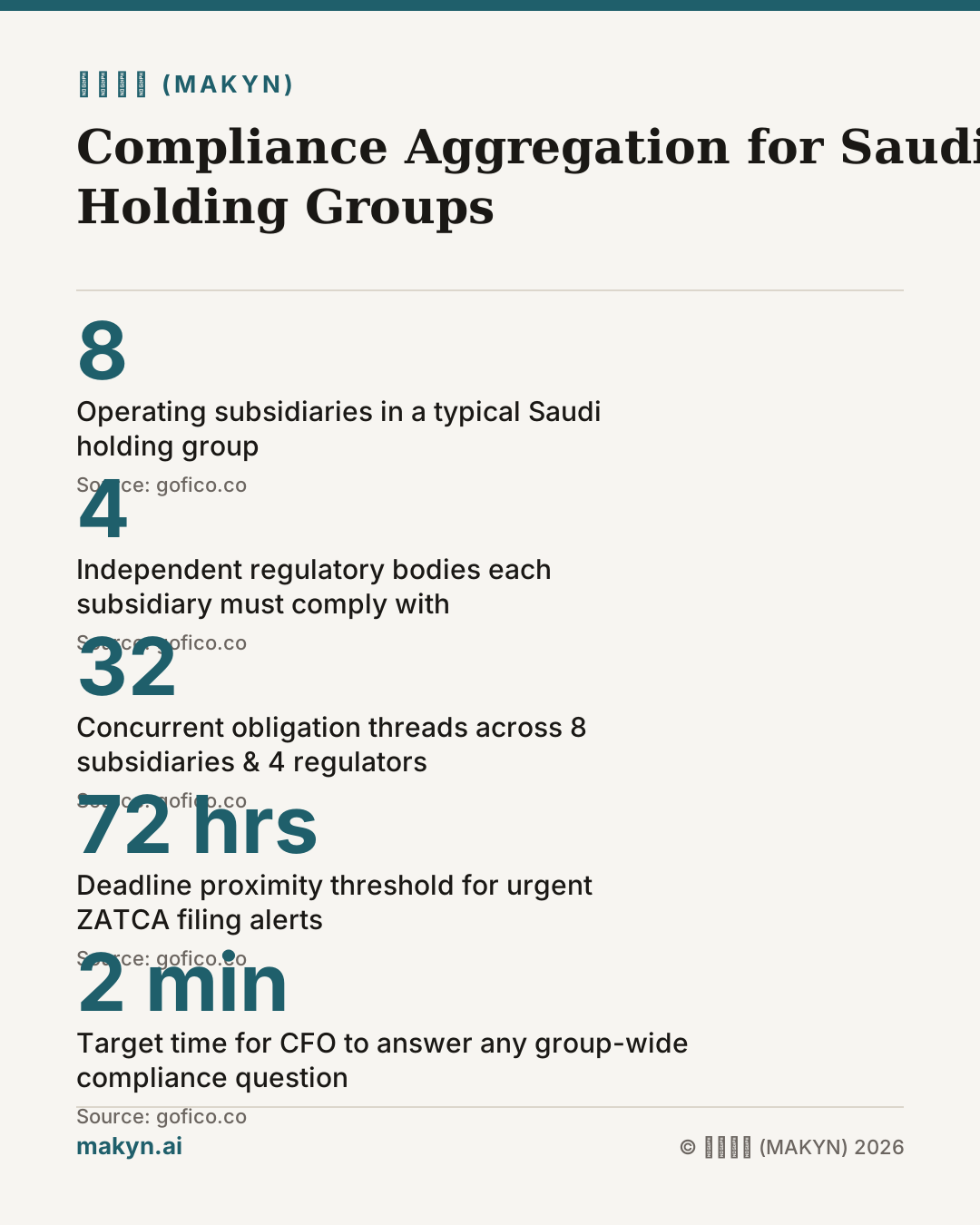
Consider the arithmetic. Eight subsidiaries, four regulatory bodies, produces up to 32 concurrent obligation threads at any given time. These threads are not synchronized. A ZATCA filing deadline does not wait for the team to finish processing a GOSI contribution for a different entity. A Qiwa Nitaqat band review does not pause because three municipal license renewals landed in the same week. When a linear team moves sequentially through these threads, the later threads accumulate latency — and latency in regulatory compliance is not merely inefficiency. It is exposure.
The deeper failure is epistemological: the group CFO has no consolidated view. The finance director at Subsidiary D may know that their GOSI contributions are current. No one at the group level knows, in real time, the aggregate risk posture across all eight entities. Questions that a group CFO should be able to answer in under two minutes — which subsidiaries have open regulatory notices right now, which Qiwa establishments are at a Nitaqat band that threatens workforce quota, which ZATCA filings are within 72 hours of a deadline — require manual aggregation that, by the time it is complete, may already be out of date.
Saudi Arabia's regulatory infrastructure has become increasingly digital and interconnected, with government systems designed to verify business information across multiple authorities [1]. That cross-system connectivity is a feature for regulators and a compounding risk for any holding group whose internal compliance tracking remains fragmented.
The Multiplication Problem Across ZATCA, GOSI, Qiwa, and Municipal Licensing
Each of the four primary regulatory bodies imposes a distinct obligation profile on every subsidiary. They do not share enforcement calendars, and a lapse with one authority is not visible to another — until it is, because Saudi Arabia's regulatory systems are built to share business status information [1].
ZATCA requires each legal entity to file independently. For holding groups with subsidiaries operating across different business activities, this means separate VAT returns, separate Zakat assessments, and — for entities in Phase Two of e-invoicing — separate FATOORA compliance postures. A notice issued to Subsidiary B does not appear in Subsidiary A's portal. See the ZATCA Phase Two e-Invoicing Audit Readiness checklist for a detailed breakdown of per-entity Phase Two obligations.
GOSI contributions are due monthly per entity, calculated against each subsidiary's payroll independently. A missed contribution for one subsidiary does not surface in another subsidiary's account — it surfaces as a compliance block when that subsidiary attempts to obtain a government certificate of good standing, often at the moment a contract or license renewal requires one.
Qiwa tracks Saudization (Nitaqat) ratios at the establishment level, not the group level. A holding group may have a strong aggregate Saudization rate that conceals a single subsidiary sitting in a Red or Yellow Nitaqat band. That subsidiary's workforce quota is at risk, but the group-level view shows nothing alarming. For accounting offices navigating similar Nitaqat structures, the Nitaqat Compliance for Accounting Offices article covers the risk tier mechanics in detail.
Municipal licensing timelines vary by municipality and activity classification. A subsidiary operating in a different region from the holding group's headquarters will have renewal dates that do not align with the group's internal reporting cycles — a silent drift that becomes visible only when renewal lapses.
The Architecture That Actually Works: Group-Level Aggregation, Entity-Level Trails
The correct architectural response to this problem is not more staff assigned to subsidiary-level tracking. It is a system that inverts the information flow: instead of each entity reporting upward to the group when something goes wrong, all regulatory signals are ingested at the group level automatically and surfaced by urgency and entity.
This architecture has two non-negotiable components.
First: aggregated obligation visibility. Every deadline, notice, and status change across all subsidiaries and all regulatory bodies must be visible in a single interface, sortable by entity, by regulator, and by days-to-deadline. The group CFO needs to know — without making a phone call — which of the eight subsidiaries requires action today, and specifically what that action is. As discussed in The Case for a Unified Compliance Register Across Client Portfolios, the discipline of centralizing obligation tracking is what separates proactive compliance from permanent fire-fighting.
Second: entity-level audit trails. Aggregation at the group level must not flatten the entity-level record. Every action taken — every notice acknowledged, every filing submitted, every response sent — must be logged against the specific subsidiary and the specific regulatory authority. This is not optional: Saudi regulatory enforcement operates at the entity level, and audit recall requirements mean that a group must be able to produce, for any individual subsidiary, a complete chronological record of its compliance actions on demand. The Audit Trails for Regulatory Notices: What Saudi Law Actually Requires article sets out the specific recordkeeping standards that apply.
These two components together solve the core problem: the group CFO has consolidated risk visibility; the auditor or regulator has granular entity-level evidence. Neither is sacrificed for the other.
What a Compliant Holding Group Structure Looks Like in Practice
A group that has implemented obligation aggregation correctly can answer the following questions in under two minutes, without querying individual subsidiary teams:
- How many open regulatory notices exist across all entities, and which are past their response window?
- Which subsidiaries have GOSI contributions due in the next 10 days?
- Which Qiwa establishments are currently in a Nitaqat band below the required threshold?
- Which municipal licenses expire within the next 90 days, and which subsidiaries do they belong to?
- Which entities have a ZATCA filing cycle opening within the next two weeks?
- Which subsidiaries have no open issues — confirmed clean, not merely untracked?
The last question is as important as the first five. In a fragmented tracking environment, "no news" from a subsidiary is ambiguous — it may mean the subsidiary is compliant, or it may mean the subsidiary's compliance officer has not yet logged into the relevant portal. In an aggregated system, a confirmed-clean status is meaningfully different from an unknown status. That distinction is what allows a group CFO to escalate accurately rather than reactively.
For groups using a Qiwa–GOSI compliance dashboard, real-time status confirmation across both labor regulators becomes the baseline expectation rather than an aspiration.
The Interconnection Risk That Amplifies Every Gap
Saudi Arabia's regulatory systems share business status data across authorities [1]. This means that a compliance failure in one system has a realistic probability of appearing as a block in a different system — and at a moment the group did not choose. A subsidiary with a suspended commercial registration cannot easily participate in group-level government contracting. A subsidiary flagged by GOSI for outstanding contributions may encounter obstacles when the group attempts to process expatriate visa renewals through a shared PRO function.
The aggregation problem, in other words, is not merely an internal reporting problem. It is a risk that propagates externally, into the group's commercial relationships, its financing arrangements, and its workforce management. The compliance surface of the least-managed subsidiary becomes, in effect, a risk surface for the entire group.
This is why subsidiary-by-subsidiary tracking is not a conservative approach — it is a structurally exposed one. The group that treats each entity as an isolated compliance responsibility has not reduced risk; it has distributed it in a way that prevents centralized detection.
MAKYN's View
The argument for obligation aggregation is not primarily a technology argument. It is an organizational design argument: a group CFO cannot govern what the group cannot see in aggregate. The technology question — which system provides the aggregated view while preserving entity-level audit trails — is secondary to the architectural decision that such a view is a requirement, not a luxury.
What we observe in practice is that holding groups frequently invest in subsidiary-level compliance tooling — dedicated accounting software per entity, separate HR system logins per subsidiary — without investing in the layer that sits above them and provides consolidated visibility. The result is a collection of well-managed silos. Each silo may be competently run. The group, as a unit, remains blind.
MAKYN's compliance infrastructure is designed for exactly this configuration: a single platform that ingests regulatory signals across all entities, maintains entity-level audit trails, and surfaces group-level risk by urgency. The system reads Arabic-language notices as the source of truth, routes actions to the correct entity owner, and logs every step for audit recall. A group with eight subsidiaries gets eight audit trails and one consolidated view — not eight separate dashboards requiring manual synthesis.
If you are a group CFO or compliance director managing subsidiaries across multiple Saudi regulatory bodies, the right starting point is an honest audit of what you can see in aggregate right now. Request a demonstration to see how obligation aggregation works across a live multi-entity structure.
For groups evaluating compliance software at the group level, the Evaluating Saudi Compliance Management Software: A Buying Framework article provides a structured evaluation methodology that applies directly to holding group procurement decisions.
Frequently asked
- What compliance obligations apply to every subsidiary in a Saudi holding group?
- Each operating subsidiary must independently meet obligations across four primary regulators: the Zakat, Tax and Customs Authority (ZATCA) for tax filings and e-invoicing, the General Organization for Social Insurance (GOSI) for monthly contributions, Qiwa for labor contracts and Saudization quotas, and the relevant municipal authority for commercial licensing renewals. These obligations run on different calendars and are enforced against each legal entity separately.
- Why can't a holding group's central compliance team simply manage each subsidiary one by one?
- Sequential entity-by-entity management introduces timing gaps. While the team is resolving a ZATCA notice for Subsidiary C, a GOSI deadline for Subsidiary F may pass unnoticed. With eight subsidiaries and four regulatory bodies, that produces up to 32 concurrent obligation threads. A central team working linearly cannot maintain real-time visibility across all threads — blind spots are structural, not a staffing failure.
- What is obligation aggregation at the group level, and how does it differ from a shared spreadsheet?
- Obligation aggregation means a single system ingests all regulatory deadlines, notices, and status changes across every subsidiary and presents them in a unified risk view — organized by urgency, entity, and regulator. A shared spreadsheet requires manual updates and lacks automatic ingestion of notices from ZATCA, GOSI, or Qiwa portals. Aggregation systems maintain live entity-level audit trails while giving the group CFO a consolidated status layer above them.
- What are the consequences of a compliance blind spot in one subsidiary for the wider holding group?
- In Saudi Arabia's increasingly interconnected regulatory environment, a block in one authority's system can cascade. A suspended commercial registration in one subsidiary may complicate group-level financing, visa processing for shared staff, or consolidated tax reporting. The reputational and operational risk is not contained at the entity where the lapse occurred — it surfaces at the group level, often at the worst possible moment.
Sources
- 1. Saudi Business Compliance: A Complete 2026 Guide | GOFICO — gofico.co