AI Bookkeeping Tools Miss What Saudi Offices Need
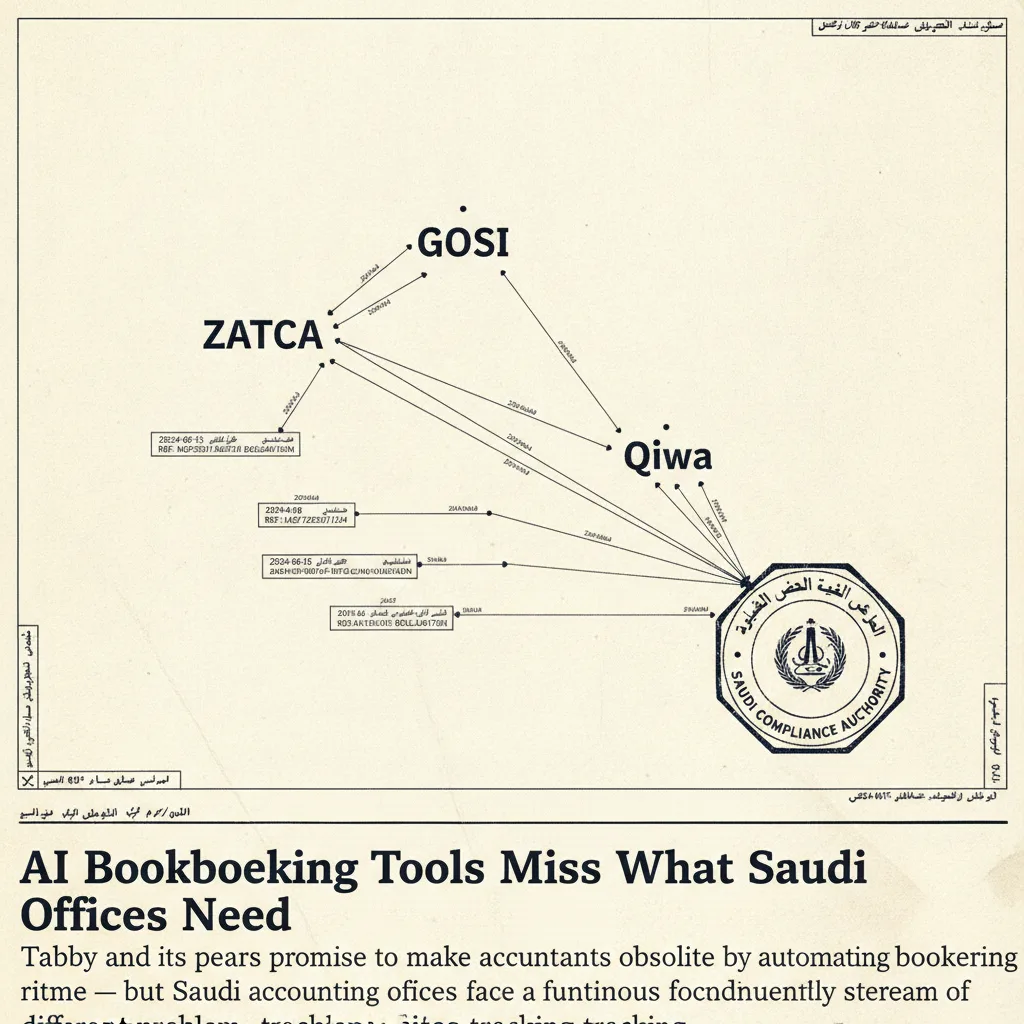
An accountant in the United States cancels his QuickBooks subscription, builds an AI that reads bank feeds in real time, and declares bookkeeping automated. The story is coherent for the market it addresses. Saudi accounting offices, however, are not staring at a bookkeeping backlog. They are staring at an unmanaged queue of regulatory notices from the Zakat, Tax and Customs Authority (ZATCA), the General Organization for Social Insurance (GOSI), the Human Resources Development Fund's Qiwa platform, and municipal licensing bodies — each carrying its own deadlines, its own penalty schedule, and its own portal logic. The two problems are not the same. Treating them as interchangeable is where the real risk lives.
What AI bookkeeping tools actually do — and what they skip
Tabby, as described in reporting from TechCrunch, connects to live financial accounts via Plaid, uses AI to categorize transactions, and delivers a real-time profit-and-loss dashboard to business owners and their accountants [1]. The founders' diagnosis is that small businesses suffer from too much accounting software complexity, and the proposed remedy is a layer that simply does the bookkeeping for them [1].
This is technically coherent automation for a specific task: converting raw bank transactions into organized financial records. What it does not do — by design, not by oversight — is monitor government portals, parse Arabic-language regulatory notices, log receipt of a ZATCA circular, or alert a finance team that a Saudization (Nitaqat) tier reclassification has changed the compliance obligation for one of their clients. Those functions were never in scope.
General-purpose AI bookkeeping tools share this boundary. Their data model is built around transactions. A regulatory notice is not a transaction. It is a structured legal event that demands a timestamped response, a documented acknowledgment, and in many cases an action within a hard deadline. No ledger captures it automatically.
The Saudi compliance stack is not a bookkeeping problem
A mid-sized accounting office in Riyadh managing 300 client entities can receive upward of several hundred regulatory notices per month across ZATCA, GOSI, Qiwa, and municipal authorities. Each notice type behaves differently. A ZATCA inspection letter requires a formal written response within a specified window. A GOSI contribution discrepancy notice triggers a reconciliation process. A Qiwa labor compliance alert may require an updated Saudization plan. A municipal license renewal carries a lapse-and-fine sequence if missed.
None of these arrive as accounting entries. They arrive through separate portals, in Arabic, as PDFs or structured messages, often with no automated forwarding to the firm's primary workflow. The accountant who is heads-down reconciling VAT returns in a bookkeeping tool is not, at that same moment, checking four government portals for new notices. The gap between arrival and acknowledgment is where penalties accumulate.
ZATCA's own behavior illustrates how rapidly the regulatory surface can shift. In June 2026, ZATCA announced the Minister of Finance's decision to extend the "Cancellation of Fines and Exemption of Financial Penalties Initiative" for six additional months beginning 1 July 2026 [2]. The initiative covers late registration, late payment, and late filing of returns across all tax laws — but with explicit carve-outs for tax evasion penalties, fines under Article 45 of the VAT Law, and any return due after 30 June 2026 [2]. An office that missed this announcement and advised a client to delay filing on the assumption that the old initiative terms still applied would have given materially incorrect guidance. That is not a bookkeeping failure. It is a regulatory intelligence failure.
For more on the audit trail implications of ZATCA's electronic invoicing requirements, see سجل المراجعة للفواتير الإلكترونية: متطلبات زاتكا والفجوة الخفية.
Where generic automation creates real regulatory exposure
The exposure pattern is consistent. A Saudi finance team adopts an AI bookkeeping tool. Efficiency improves — transaction categorization is faster, monthly closes are cleaner, the P&L is always current. Leadership interprets this as "automation handling compliance." The regulatory notice queue, however, continues to accumulate in a separate portal that no one has formally assigned to a workflow.
The specific failure modes:
- Notice receipt without action assignment. A ZATCA field audit notification arrives in the company's Fatoora portal. No one is assigned to monitor that portal daily. The notice ages past its response window.
- Initiative term misread. A client believes it qualifies for the fines-exemption extension announced by ZATCA in June 2026, but the specific return type falls under the Article 45 exclusion [2]. The bookkeeping tool has no mechanism to flag this distinction.
- Saudization tier reclassification missed. Qiwa reclassifies a client entity from green to yellow tier based on headcount changes. The Nitaqat obligations shift immediately. The accounting office's AI bookkeeping tool does not read Qiwa. See نطاقات والسعودة: ما يجب على كل صاحب عمل معرفته for the full obligation structure.
- GOSI contribution deadline drift. A payroll input error shifts a contribution amount. GOSI issues a discrepancy notice. The AI tool reconciled the payment as posted — the discrepancy lives in the regulatory layer, not the ledger.
Each of these is a compliance failure that no bookkeeping automation is positioned to catch. The tool is doing its job correctly. The problem is the assumption that the tool's job encompasses compliance.
For a structured view of where AI tools specifically fall short in the Saudi tax compliance context, see لماذا لا تكفي الذكاء الاصطناعي وحده في الامتثال الضريبي.
What purpose-built regulatory intelligence looks like for Saudi offices
The distinction is architectural, not cosmetic. A regulatory intelligence layer for a Saudi accounting office must do four things that bookkeeping tools do not:
- Ingest notices as structured events. Every incoming notice from ZATCA, GOSI, Qiwa, or a municipal body is captured as a discrete record with a receipt timestamp, an issuing authority, a deadline, and a required action type.
- Assign ownership. Each notice is routed to a named responsible party within the office or at the client entity. Unassigned notices do not exist in the system; they trigger an escalation.
- Maintain a tamper-evident audit trail. Acknowledgment, response, and resolution are logged with timestamps. If an auditor asks when a notice was received and what action was taken, the answer is retrievable in seconds, not reconstructed from email threads.
- Surface regulatory changes as actionable events. When ZATCA announces a change to an initiative — as it did in June 2026 with the fines-exemption extension and its exclusions [2] — the system flags which clients are affected, what the deadline is, and what action is required. This is not a search function. It is a push function.
This is the layer that the current generation of AI bookkeeping tools does not address. It is also the layer where the largest penalty exposure accumulates.
For a deeper analysis of how accounting offices should systematically handle ZATCA notifications, see How Accounting Firms Should Track ZATCA Notifications Systematically.
MAKYN's view: efficiency tools and compliance tools solve different problems
The accountant who built Tabby is correct that bookkeeping is automatable [1]. The work of converting bank transactions into organized financial records is well-suited to AI — it is high-volume, pattern-driven, and language-agnostic. Saudi offices should adopt tools that automate it well.
The error is in the next inference: that automating bookkeeping means compliance is handled. In the Saudi context, compliance is not primarily a bookkeeping problem. It is a regulatory notice management problem. The entities that generate obligations — ZATCA, GOSI, Qiwa, municipal authorities — communicate through portals, letters, and circulars that operate entirely outside any accounting ledger. The obligations they create are not transaction categories. They are legal events with hard deadlines.
An office that deploys bookkeeping automation and declares compliance automated has, in effect, removed the manual accountant who used to notice the notice. It has replaced that person with a tool that, by design, is not watching the same portals.
The practical consequence is that the efficiency gains are real and the compliance gap widens simultaneously. Senior partners assume the technology is covering both layers. Junior staff assume someone else is watching the regulatory portals. No one is.
Purpose-built compliance management for Saudi offices means treating the regulatory notification layer as a primary workflow, not an afterthought to bookkeeping. It means every notice is a structured event, every deadline is tracked, and every response is logged before the penalty window closes. Bookkeeping automation and regulatory intelligence are complementary tools — but they are not the same tool, and one does not substitute for the other.
Saudi accounting offices that want to understand where their current workflow leaves notice management unaddressed are welcome to اطلب عرضاً توضيحياً to see how a purpose-built regulatory intelligence layer integrates with existing accounting workflows.
Frequently asked
- What does an AI bookkeeping tool like Tabby actually do?
- Tabby connects to live bank and financial data via Plaid, uses AI to categorize transactions, and produces a real-time profit-and-loss dashboard. It is designed to reduce the manual labor of bookkeeping — transaction entry, reconciliation, and financial reporting. It does not monitor regulatory portals or parse compliance notices from government authorities.
- Why isn't general-purpose AI bookkeeping sufficient for Saudi compliance?
- Saudi businesses must track notices from multiple authorities — ZATCA for tax and zakat, GOSI for social insurance, Qiwa for labor and Saudization, and municipal bodies. These notices carry deadlines and penalties that exist entirely outside the accounting ledger. A tool built to automate bookkeeping has no mechanism to detect, log, or escalate a ZATCA circular or a Nitaqat tier reclassification.
- What was ZATCA's June 2026 fines-exemption initiative?
- ZATCA announced in June 2026 that the Minister of Finance extended the 'Cancellation of Fines and Exemption of Financial Penalties Initiative' for six additional months from 1 July 2026. It covers late registration, late payment, and late filing penalties across all tax laws, but explicitly excludes tax evasion fines and penalties on returns due after 30 June 2026.
- What should a purpose-built compliance tool for Saudi offices do differently?
- It should ingest notices from ZATCA, GOSI, Qiwa, and municipal authorities as structured data; assign each notice a deadline and a responsible party; maintain a timestamped audit trail; and escalate unresolved items before the penalty window closes. This is a regulatory intelligence layer — distinct from, and complementary to, bookkeeping automation.
Sources