ZATCA Notification Tracking for Accounting Firms
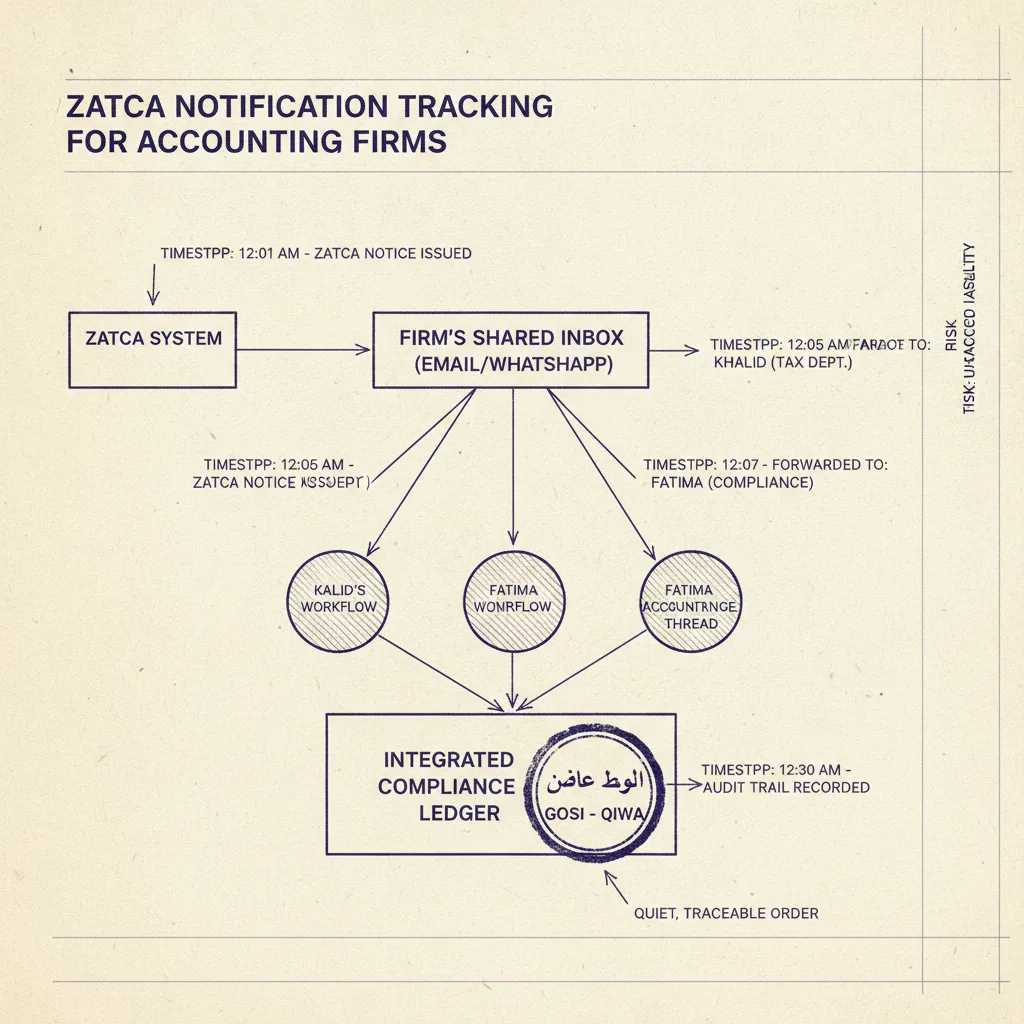
An accounting firm in Riyadh receives a ZATCA notice about a VAT discrepancy for one of its clients. The notice arrives in a shared Gmail account. Someone forwards it to a WhatsApp group. Three people read it. Nobody records who acknowledged it or when. Six weeks later, a ZATCA auditor asks for proof that the firm responded within the required window. The firm has a message thread. The auditor has a standard.
This is not an edge case. It is the ordinary operational reality of a significant portion of accounting practices in Saudi Arabia — and it is exactly the gap that a structured notification tracking system is designed to close.
Why Informal Routing Is a Compliance Liability
Penalties for ZATCA non-compliance range from SAR 1,000 to SAR 50,000 per violation [1]. That figure is concrete enough to motivate attention. What it does not capture is the secondary problem: when an auditor asks for evidence of how a notice was received and acted upon, a penalty already paid does not close the matter. The auditor is evaluating process, not just outcome.
ZATCA initiates audits through several distinct channels: risk-based scoring that weighs industry type, transaction volume, and historical compliance; data analytics that flag reporting anomalies; random selection; and whistleblower reports [2]. None of these triggers require advance warning. A firm that receives a formal audit request has, at that moment, whatever records it has maintained up to that point — not whatever records it intends to maintain going forward.
A shared inbox or a WhatsApp thread fails on three measurable dimensions: it carries no reliable timestamp for individual message acknowledgment, it assigns no named accountability for each action item, and it provides no mechanism to confirm that a response deadline was met. These are not stylistic shortcomings. They are evidentiary gaps.
What ZATCA's Record-Keeping Framework Actually Requires
ZATCA's compliance framework requires businesses to maintain accounting and financial records, VAT and e-invoicing documents, payroll and employment records, banking and payment evidence, and contracts and supporting agreements [3]. Each category carries a defined retention period, and the expectation is that records are accessible and traceable — not simply stored somewhere.
A notification from ZATCA is the originating document for a chain of required actions. If a VAT assessment notice arrives and the firm calculates an amended return in response, the audit trail runs from the notice through the calculation to the filed return. If the link between the notice and the subsequent record is broken — because the notice was only ever a forwarded WhatsApp message — the entire chain loses its first link.
This is why notification tracking is not a separate administrative task sitting alongside compliance work. It is the structural spine that holds compliance documentation together.
What a Defensible Notification Log Must Contain
A tracking system that can withstand scrutiny during a ZATCA audit requires, at minimum, four elements per entry:
- Receipt timestamp — the exact date and time the notice was received by the firm, not the date someone happened to read a forwarded message.
- Named responsible party — a specific staff member assigned accountability for the notice, not a group or a role.
- Action taken — a record of the specific response: amended filing, client communication, document request, or escalation.
- Deadline status — whether the required response was submitted before the relevant deadline, with evidence attached.
A fifth element — the original notice stored as an immutable file linked to the log entry — converts the record from a tracking sheet into a retrievable archive. ZATCA's Phase Two e-invoicing integration requirements mean that the authority already has real-time visibility into invoice data [2]. A firm's notification log should match that standard of precision in the other direction.
The Operational Model Most Firms Are Using — and Why It Breaks
The typical workflow in a mid-size Saudi accounting office runs approximately as follows: ZATCA notices arrive via the Fatoora portal or official correspondence channels; someone with portal access checks them periodically; urgent items get escalated informally; routine items wait. During busy periods — around filing deadlines, quarter-end reporting cycles — the periodic check becomes irregular. Notices accumulate.
The firm believes it is managing the flow. What it is actually managing is a queue with no receipt confirmation, no assigned owner, and no deadline calendar that links back to individual notices. When the auditor arrives, the firm must reconstruct this history from memory and inbox searches. This is retroactive compliance, not systematic compliance — and the difference is visible to anyone conducting a structured audit review [2].
The volume problem compounds the risk. A practice serving multiple VAT-registered clients can receive notices across multiple portal accounts simultaneously. Without a unified log, each portal account becomes its own informal silo.
Building the System: Practical Architecture
The system does not need to be complex. It needs to be consistent. Four structural decisions determine whether a notification log functions as a compliance tool or a filing cabinet:
- Single point of ingestion — all portal accounts feed into one monitored channel with a designated person responsible for daily triage, not periodic review.
- Mandatory acknowledgment before routing — a notice is not forwarded until it has been logged with a timestamp and assigned to a responsible party. The log entry is created at ingestion, not after action is taken.
- Deadline calendar integration — every notice with a response requirement generates a calendar entry with an owner. The entry closes only when the action record is attached to the log.
- Retention-linked archiving — the log entry and the original notice are stored together in a system that preserves them for the full retention period required under ZATCA's record-keeping rules [3].
These four decisions can be implemented in a purpose-built compliance platform or, at a smaller firm, in a disciplined combination of a structured spreadsheet and a document management system. The critical variable is not the technology — it is the mandatory discipline applied at the moment of ingestion.
Makyn's View
Most accounting firms do not have a notification tracking problem. They have a documentation discipline problem that expresses itself as a notification tracking problem. The WhatsApp thread and the shared inbox are symptoms of an underlying assumption: that compliance is about knowing what to do, not about proving that it was done.
ZATCA's audit process does not evaluate intent [2]. It evaluates records. A firm that can produce a timestamped, named, action-linked log of every notice it received in the past three years is in a fundamentally different position from one that cannot — regardless of whether both firms took the same substantive actions in response to the same notices.
The investment required to build this discipline is modest. The cost of not having it arrives as a single audit request at a moment not of the firm's choosing.
If your practice is ready to move from informal routing to a structured, auditable compliance workflow, اطلب عرضاً توضيحياً to see how MAKYN supports systematic notification management across multiple client accounts.
Frequently asked
- What records must a Saudi business keep to satisfy ZATCA during an audit?
- ZATCA requires businesses to maintain accounting and financial records, VAT and e-invoicing documents, payroll records, banking and payment evidence, and contracts. Retention periods apply to each category. A notification log that ties each incoming ZATCA notice to the specific record it triggered makes retrieval faster and demonstrates a controlled compliance process to the auditor.
- What triggers a ZATCA audit, and how much warning will a firm receive?
- ZATCA initiates audits through risk scoring based on industry and transaction volume, data analytics that flag reporting anomalies, random selection, and whistleblower reports. Warning periods vary. Because any of these triggers can arrive without advance notice, an accounting firm needs a notification log that is always current — not one assembled retroactively when an audit letter lands.
- What are the financial penalties for ZATCA non-compliance?
- Penalties for ZATCA non-compliance range from SAR 1,000 to SAR 50,000 depending on the nature and severity of the violation. Missing a notice deadline or failing to produce proof of timely action can expose a firm to penalties that compound across multiple assessment periods, making an untracked inbox a recurring financial liability rather than a one-time risk.
- Can a shared WhatsApp group or email inbox substitute for a formal notification log?
- No. A shared inbox or WhatsApp thread has no reliable timestamped audit trail, no assigned accountability per notice, and no mechanism to confirm that a deadline was met. When an auditor requests proof of receipt and timely action, a message thread is not a defensible record. A structured log with mandatory acknowledgment fields is the minimum standard.
Sources
- 1. ZATCA Compliance in KSA – A Complete Guide for Businesses in Saudi Arabia — www.bmsauditing.com
- 2. ZATCA Audit Process: What to Expect and How to Prepare — fatooraplus.com
- 3. ZATCA Record Keeping Requirements in Saudi Arabia 2026 Guide — expandway.sa