A Unified Compliance Register for Accounting Offices
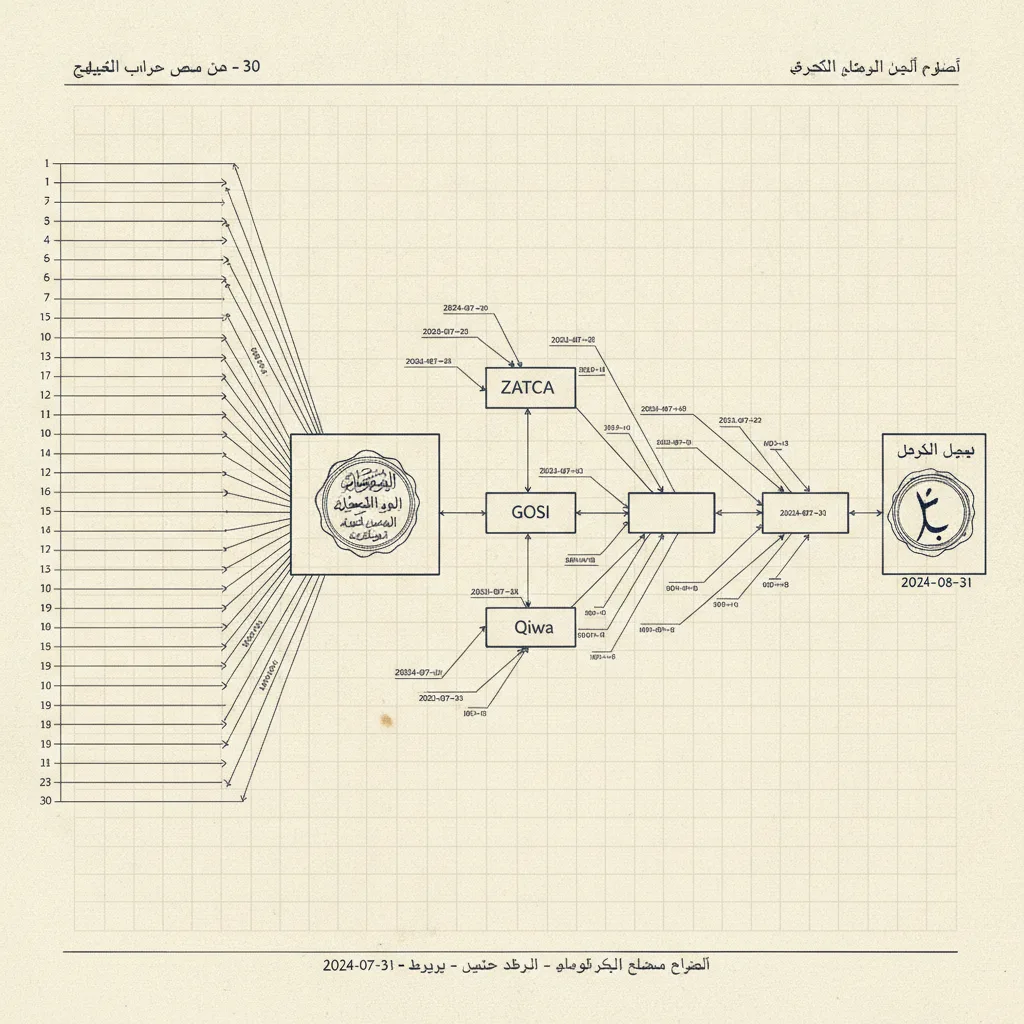
An accounting office in Riyadh managing thirty corporate clients submitted a clean audit file to هيئة الزكاة والضريبة والجمارك (ZATCA) last quarter. Three weeks later, the same office received a penalty notice from the General Organization for Social Insurance (GOSI) for a client whose GOSI contribution filing had slipped through while the team was focused on the VAT cycle. The spreadsheet tracking GOSI deadlines existed. It was simply not visible during a ZATCA-heavy month. That is the failure mode this article is about.
The arithmetic of fragmentation is unworkable at scale
A single client in Saudi Arabia typically carries obligations across at least three regulatory bodies: ZATCA (VAT filings, e-invoicing phase compliance, withholding tax), GOSI (monthly contribution deadlines, Saudization ratio reporting), and Qiwa (labor contract compliance, work-permit renewals, Nitaqat band management). Each body runs on its own calendar, its own portal, and its own penalty structure.
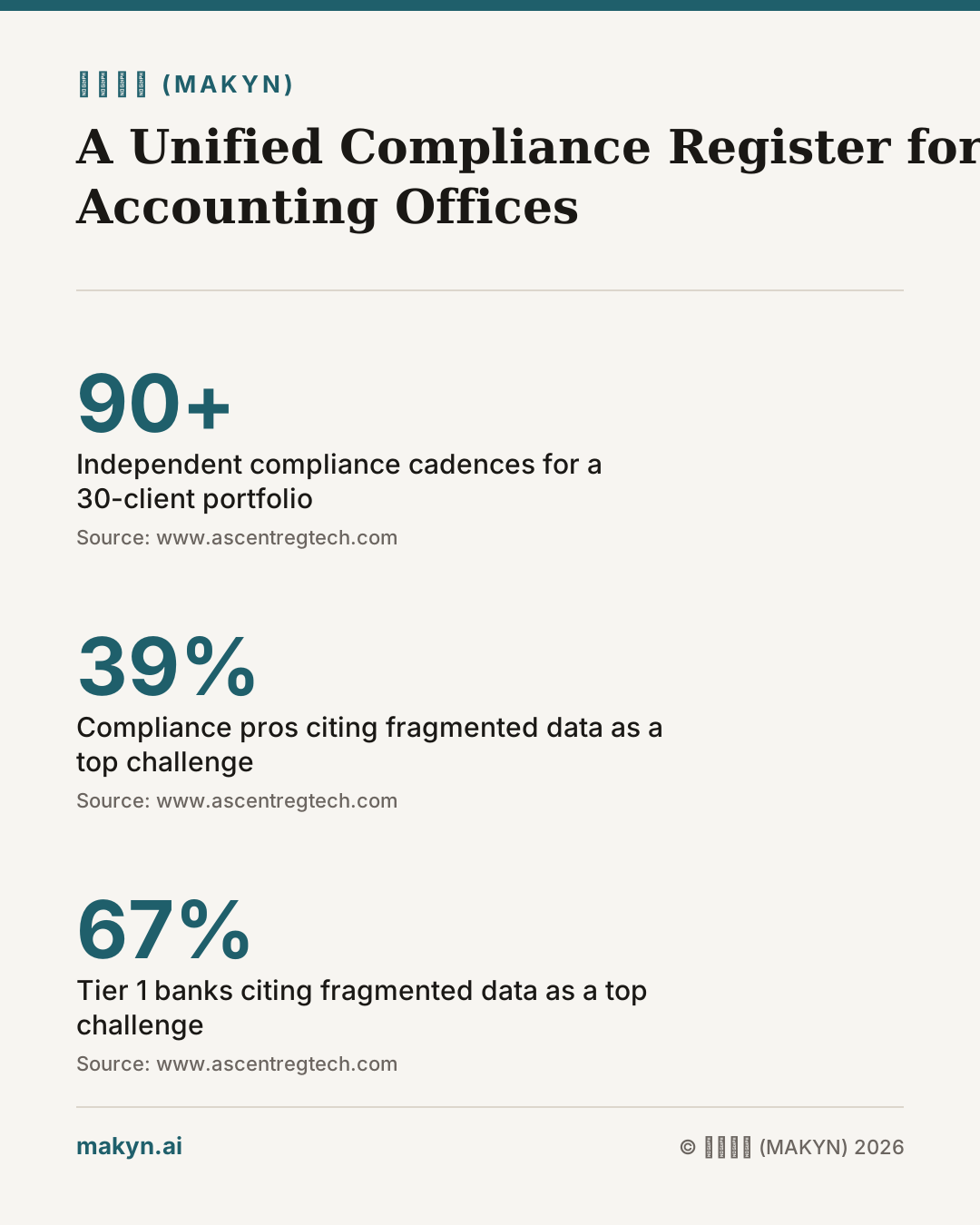
Multiply that across thirty clients and the arithmetic becomes clear: ninety or more independent follow-up cadences, each with its own deadline, its own responsible team member, and its own documentation standard. No firm runs ninety cadences cleanly in parallel on separate spreadsheets. What actually happens is that team attention gravitates toward the loudest agency at any given moment — and the quieter ones accumulate silent exposure.
This is not a discipline problem. It is a structural one. Fast-growing organizations consistently discover that compliance processes which worked at small scale collapse under volume — not because people stop caring, but because the architecture was never designed to carry the load. [1]
What fragmented data actually costs
The risks of fragmented compliance data are concrete and fall into three categories. [2]
Hidden obligation gaps. When a client's obligations are distributed across ZATCA files, GOSI spreadsheets, and Qiwa checklists, the register as a whole is never visible to any single reviewer. During obligation reviews, compliance teams regularly discover both duplicate entries that inflate apparent workload and genuine gaps where a regulation applies but was never formally mapped to a responsible owner. [2]
Change-propagation failure. Regulatory requirements in Saudi Arabia change with meaningful frequency — ZATCA's e-invoicing phases are the most visible example, but GOSI contribution rates and Qiwa platform requirements have also been revised in recent cycles. In a fragmented environment, a regulatory update requires the same correction to be applied manually across every affected file for every affected client. That chain fails silently: someone updates the template, someone else continues working from the old one.
Audit-trail inconsistency. When an auditor or a government inspector asks for the compliance history of a specific client across a specific period, a fragmented system produces a patchwork of version-dated spreadsheets with no unified narrative. Each file has its own edit history. None of them speak to each other. The evidence set is formally incomplete even when the underlying work was actually done.
In the 2026 AscentAI RegTech Benchmark Survey, 39% of compliance professionals cited fragmented data and the absence of a single source of truth as a top compliance challenge. Among Tier 1 banks, that figure rose to 67%. [2] Accounting offices serving multi-entity Saudi portfolios operate under conditions closer to those large institutions than to single-company compliance teams.
What a defensible unified register looks like
A unified compliance register integrates obligations from multiple regulatory frameworks into a single structured record, mapping common control and deadline requirements across mandates rather than maintaining each agency's obligations in isolation. [3] For a Saudi accounting office, that means one register — not one register per agency, and not one register per client — that surfaces every obligation across the entire portfolio.
The minimum viable record for each entry:
- Client entity — legal name and CR number
- Regulatory body — ZATCA, GOSI, Qiwa, Ministry of Commerce, or other
- Obligation type — VAT filing, GOSI contribution, Nitaqat review, etc.
- Deadline date — the operative date, not the agency's general cycle
- Responsible team member — named, not a team or department
- Current status — pending / in progress / submitted / closed
- Evidence link — direct reference to the filed document or portal confirmation
- Closure timestamp — append-only, not editable after the fact
The critical design choice is sort order. The register must be sorted and filtered by deadline date as the primary axis — not by client, not by agency. A team that opens the register on a Monday morning should see the seven obligations due in the next five days across all clients and all agencies. That view does not exist in a system organised by agency tab or client folder.
The difference between a spreadsheet and a register
The word "register" is used deliberately. A spreadsheet is a calculation surface. A register is an authoritative, append-only record of obligations and their resolution status. The distinction has legal and operational weight.
Spreadsheets fail as compliance infrastructure for reasons that compound at scale. [1] They have no version control that surfaces who changed what and when. They have no workflow enforcement — nothing prevents a cell from being overwritten without a trace. They have no change-propagation logic — when a regulatory deadline shifts, the person who knows must manually find and update every affected row across every affected file. And they have no structured output — producing a per-client compliance summary for an audit requires manual assembly from multiple sources.
A register, by contrast, is designed so that closed obligations cannot be altered, every status change carries a timestamp and an actor, and the current state of every obligation is derivable from the record itself without interpretive work. This is what makes it defensible under examination — not the accuracy of the data at the moment of entry, but the integrity of the record over time.
For more on how systematic tracking prevents the most common failure modes in a high-volume regulatory environment, see How Accounting Firms Should Track ZATCA Notifications Systematically and What a Qiwa–GOSI Compliance Dashboard Must Show an Accountant.
Why agency-first organisation is the wrong frame
Most accounting offices organise their compliance work the way they organise their agency relationships: ZATCA matters here, GOSI matters there, Qiwa matters somewhere else. This mirrors the structure of government portals, and it feels logical until you ask the operational question that actually drives risk: What is due in the next ten days, across all clients and all agencies, and who is responsible for each item?
An agency-first system cannot answer that question without manual aggregation across all its sub-registers. The answer arrives too late, after someone has already compiled it from multiple sources, which is precisely the moment errors are introduced.
A deadline-first register answers that question by default. The next critical action is always the top row. The agency column is a filter, not the primary sort. This inversion — from agency-organised to deadline-organised — is the single most consequential architectural change an accounting office can make to its compliance infrastructure.
The same principle applies to client portfolio management. A client-first view is useful for client reporting. It is not useful for operational prioritisation across a portfolio. The register must serve both views: deadline-sorted by default, filterable by client or agency on demand.
MAKYN's view
The unified compliance register is not a technology problem first. It is a data model problem. Before any software discussion, an accounting office needs to resolve three questions: What is the complete list of obligations this office is responsible for tracking, across all clients and all agencies? Who owns each obligation by name? And what does "closed" mean — submission confirmation, portal acknowledgement, or something else?
Offices that skip those questions and move directly to tool selection end up automating their existing fragmentation rather than resolving it. The result is a faster spreadsheet, not a register.
Once those questions are answered, the operational case for purpose-built infrastructure becomes straightforward. Spreadsheets cannot enforce append-only records, cannot propagate regulatory changes across an entire portfolio simultaneously, and cannot produce the kind of structured audit trail that protects an office when a client's compliance history is examined. [1] [2] The question is not whether the current system will fail under scale — it is when, and which client's exposure will surface first.
A well-structured unified register also positions an accounting office to use AI-assisted tools responsibly. Systems that read and route regulatory notices are only as reliable as the register they write into — a fragmented target produces fragmented output regardless of how capable the underlying model is. For a fuller treatment of that dependency, see Why AI Agents Can't Be Governed by Policy PDFs Alone.
If you are ready to assess what a unified compliance infrastructure would require for your specific client portfolio, اطلب عرضاً توضيحياً for a structured review of your current architecture against the standard described here.
Frequently asked
- What is a unified compliance register for accounting offices?
- A unified compliance register is a single structured record that consolidates every regulatory obligation — across ZATCA, the General Organization for Social Insurance, Qiwa, and any other agency — for all clients in a portfolio. Obligations are sorted by deadline date rather than by issuing agency, so the team always sees the next critical action without switching between systems.
- Why do spreadsheets fail when an office manages more than a handful of clients?
- Spreadsheets have no version control, no automatic change propagation, and no structured audit trail. When a regulation changes, every affected cell in every file must be updated manually — a process that routinely produces duplicate entries, outdated language, and unassigned obligations. Research shows that 39% of compliance professionals name fragmented data as a top challenge; that figure reaches 67% among large institutions.
- What are the three structural risks of fragmented compliance data?
- First, hidden obligation gaps — when obligations live in separate files, it is easy to miss that a regulation applies at all. Second, change-propagation failure — a regulatory update must be manually replicated across every affected document. Third, audit-trail inconsistency — different files carry different version histories, making it impossible to produce a coherent evidence set under examination.
- How should a unified register be structured to remain defensible under audit?
- Each record should carry at minimum: the client entity, the regulatory body, the specific obligation type, the deadline date, the responsible team member, the current status, and a link to the underlying evidence document. The register must be append-only for closed obligations, with timestamps. Sorting and filtering by deadline — not by agency — is the operational priority, not aesthetic grouping.
Sources
- 1. Why fast-growing companies can't scale on spreadsheets — legal.thomsonreuters.com
- 2. Fragmented Compliance Data Is Both Inefficient, and a Risk — www.ascentregtech.com
- 3. Unified Compliance: Definition and Key Concepts — www.securview.com