Managing Multi-Client Compliance Without Delegation Failure
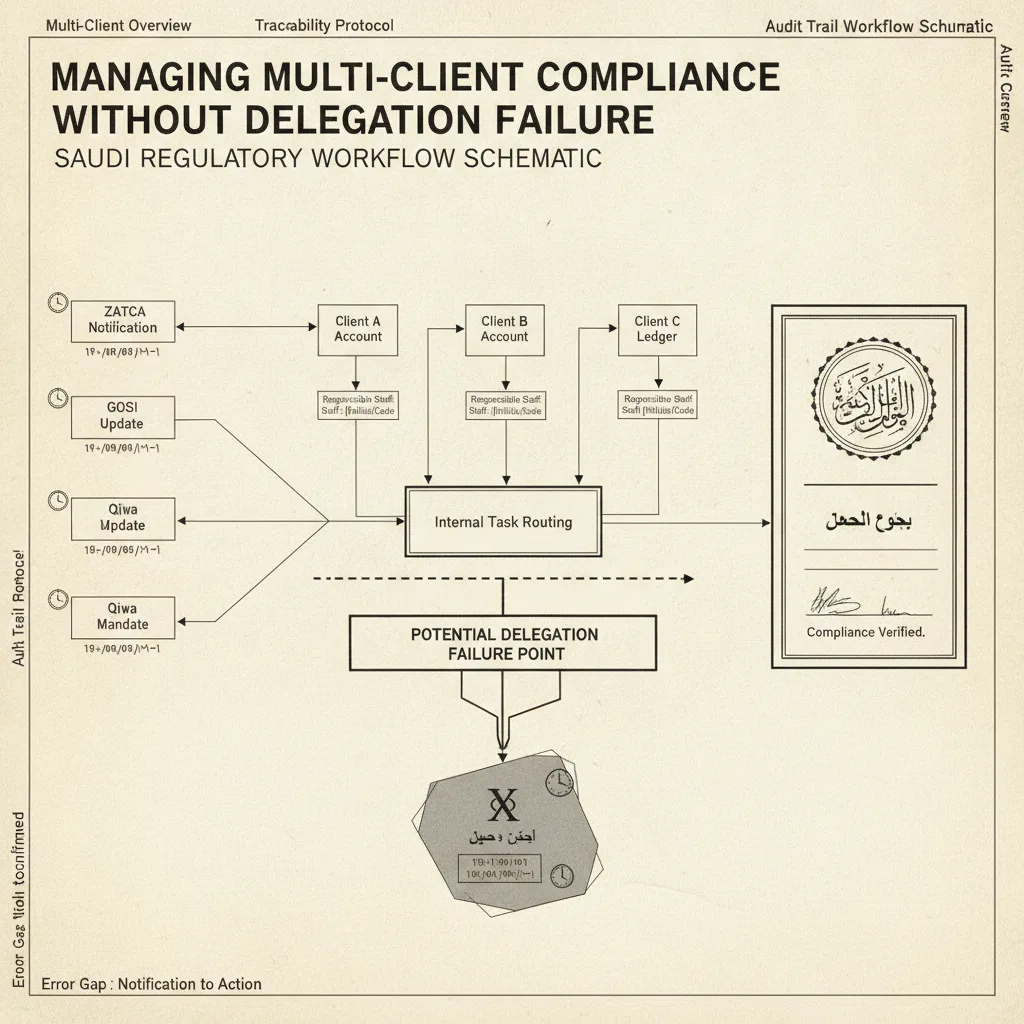
A notice from the Zakat, Tax and Customs Authority (ZATCA) arrives in the firm's portal on a Tuesday morning. By Thursday, the client's VAT response window is two days shorter. Nobody acted — not because the team lacked training, but because the notice sat in a shared inbox while the responsible accountant managed three other client deadlines. The file moved when someone happened to check. That sequence is the delegation gap, and it is the dominant failure mode in Saudi accounting offices managing multiple clients simultaneously. [3]
The delegation gap is not a knowledge problem
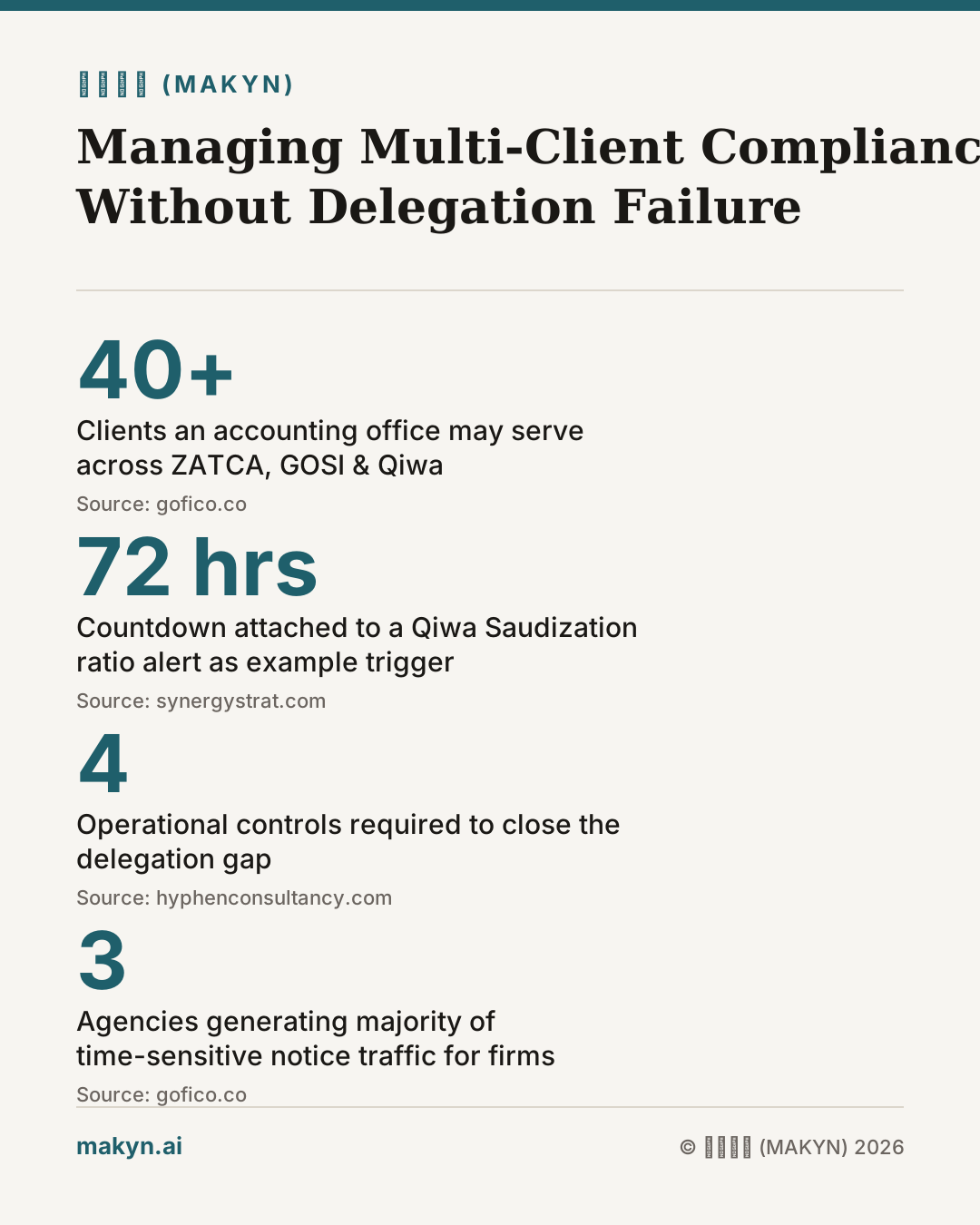
Firms investing in regulatory training operate on a reasonable assumption: if staff know the rules, compliance follows. The assumption breaks at scale. An accounting office serving 40 or more clients across ZATCA, the General Organization for Social Insurance (GOSI), and the Qiwa platform faces a volume of recurrent notices, deadlines, and response requirements that no individual can triage manually with consistent reliability. [3]
The knowledge gap and the delegation gap are structurally different failures:
- Knowledge gap: The team does not know what a ZATCA field audit notice requires. Solved by training and documentation.
- Delegation gap: The team knows exactly what to do, but the notice arrived in a general inbox, no one was explicitly named, and the deadline eroded before a conversation happened. Solved only by operational routing controls — not by more training.
Conflating the two leads firms to invest in the wrong remedy. A compliance manual does not route a GOSI inspection flag to the payroll specialist responsible for that client. A training session does not attach a 72-hour countdown to a Qiwa Saudization ratio alert. [1]
What the compliance landscape actually requires across three agencies
Saudi Arabia's regulatory environment has grown more connected and digitally verifiable over the Vision 2030 reform period. Three agencies generate the majority of time-sensitive notice traffic for accounting offices: [3]
- ZATCA — e-invoicing compliance checks, VAT assessments, Fatoora integration verification, and field audit notifications arrive on independent, often irregular timelines. Each notice type carries a different statutory response window.
- GOSI — monthly contribution deadlines are fixed but managing them across 40+ client payrolls requires a calendar control, not memory. Periodic inspection flags require faster response.
- Qiwa — Saudization ratio alerts and work-permit renewal reminders operate on timelines tied to each client's workforce profile, meaning no two clients share an identical calendar.
Because each agency operates independently, a consolidated view does not exist by default. The firm that lacks a structured intake process sees these notices as they happen to surface — which means the sequence is determined by inbox order, not by deadline urgency. [3] For a deeper look at what a combined Qiwa–GOSI view should include, see What a Qiwa–GOSI Compliance Dashboard Must Show an Accountant.
The four operational controls that close the delegation gap
Closing the gap requires controls at four distinct points in the notice lifecycle. Each control addresses a specific failure mode: [1] [2]
1. Structured intake — capture at point of arrival
Every notice from every agency must be captured into a single log the moment it arrives, with three fields recorded immediately: the client it concerns, the agency that issued it, and the earliest possible response deadline. An unlogged notice is an unmanaged notice. Firms that rely on portal browsing or email monitoring as the intake mechanism will miss notices under load.
2. Role-based accountability matrix — name the person, not the team
Shared accountability is no accountability. For each client, each agency must map to a single named staff member who owns the response. This matrix — client × agency × responsible person — is the structural document that converts a notice into an assigned task. When a GOSI flag arrives for Client A, the matrix eliminates any ambiguity: one person is named, the task is theirs. [1]
3. Deadline-anchored routing — attach the clock to the assignment
Assigning a notice without attaching its deadline converts an urgent task into an undifferentiated item in someone's queue. The routing step must include: the statutory response window, the internal action deadline (set before the statutory limit), and the escalation trigger if the action deadline passes without confirmation of action taken. This is the mechanism that turns a calendar into a control, not a record.
4. Audit trail — confirm action, not just receipt
The distinction between "the notice was received" and "the required action was completed" is the compliance gap that audit scrutiny will find first. Every closed notice must record what action was taken, when, and by whom. This trail serves two purposes: it gives the engagement partner visibility into real-time client exposure, and it produces the documentation required during a ZATCA field audit or GOSI inspection. [2]
For a systematic approach to the first control specifically, see How Accounting Firms Should Track ZATCA Notifications Systematically.
Why technology alone does not solve it — and why process alone does not either
A common response to the delegation problem is to purchase a compliance dashboard. A second common response is to redesign the firm's internal workflow. Both responses, implemented in isolation, fail. [1]
A dashboard that surfaces notices but has no routing rules attached is an improved version of the shared inbox — better visibility, same delegation gap. A process document that names responsibilities but is not enforced by a system that captures and routes notices in real time relies on staff to self-administer a discipline that human attention cannot sustain across 40+ clients under deadline pressure.
The control architecture that works combines both: a system that captures and routes, governed by a process that names and assigns. Neither substitutes for the other. This is also why governance-by-PDF fails in AI-augmented compliance contexts — the same structural principle applies whether the routing agent is human or automated. See Why AI Agents Can't Be Governed by Policy PDFs Alone for the parallel logic.
Building the accountability matrix in practice
The accountability matrix is the firmest foundation a multi-client practice can lay. In practice, it takes the following form: [1] [2]
| Client | ZATCA Owner | GOSI Owner | Qiwa Owner | Engagement Partner |
|---|---|---|---|---|
| Client A | Staff Member 1 | Staff Member 2 | Staff Member 2 | Partner X |
| Client B | Staff Member 3 | Staff Member 1 | Staff Member 3 | Partner Y |
| Client C | Staff Member 2 | Staff Member 3 | Staff Member 1 | Partner X |
Three principles govern this matrix:
- No cell is blank. A blank cell means no owner. No owner means the delegation gap is open by design.
- The engagement partner is named as escalation, not as primary owner. Partners who handle primary triage do not scale across 40 clients. Their role is escalation when the action deadline passes.
- The matrix is reviewed quarterly. Staff turnover and client onboarding change the ownership picture. A matrix that reflects last year's team is not a control — it is a liability.
For the broader software evaluation that supports this architecture, the Evaluating Saudi Compliance Management Software: A Buying Framework provides a structured approach to selecting tools that enforce, rather than merely document, these controls.
MAKYN's view
The firms that manage multi-client compliance without delegation failure share one structural habit: they treat notice routing as infrastructure, not as a task. The inbox is not the system. The spreadsheet is not the system. The system is the rule that says — when this notice arrives, this person is notified, with this deadline, and the confirmation that action was taken is recorded here.
What distinguishes a compliance operation that scales from one that accumulates risk silently is not the quality of the regulatory knowledge inside the team. It is whether the gap between notice arrival and responsible action is governed by a designed control or by whoever happens to check their inbox first.
MAKYN reads incoming notices from ZATCA, GOSI, and Qiwa, extracts the client, the agency, the deadline, and the required action, and routes each item to the named owner with the deadline attached — replacing the shared inbox with a structured intake that closes the delegation gap at point of arrival. If your firm is managing compliance across multiple clients and the current process depends on individual attention rather than system-enforced routing, اطلب عرضاً توضيحياً to see how the control architecture works in practice.
Frequently asked
- What is the delegation gap in Saudi compliance management?
- The delegation gap is the interval between a regulatory notice arriving — from ZATCA, GOSI, or Qiwa — and the staff member responsible for that client seeing it. During that interval, deadlines erode. It is distinct from a knowledge gap: the team may know exactly what to do but never receive a clear, timely signal that action is required on a specific client file.
- How should an accounting firm structure accountability across 40+ clients?
- Build a role-based accountability matrix: one named person per client per regulatory authority, not a shared inbox. Pair it with a closing calendar that maps each agency's recurrent deadlines. When a notice arrives, the system routes it to the named person with the deadline attached — removing ambiguity about who acts and by when.
- Which Saudi authorities generate the highest notice volume for accounting firms?
- ZATCA generates the most frequent touch points through e-invoicing compliance, VAT assessments, and Fatoora integration notices. GOSI produces monthly contribution deadlines and periodic inspection flags. Qiwa triggers Saudization ratio alerts and work-permit renewal reminders. Each authority operates on independent timelines, which is why consolidated tracking across all three is necessary.
- Why does adding more staff not solve the multi-client compliance problem?
- Additional staff increases capacity but not coordination. Without a structured intake and routing system, each new hire inherits the same manual triage problem at a larger scale. The constraint is not hours — it is the absence of a rule that says: when notice X arrives for client Y, it reaches person Z within a defined window. More staff without that rule simply creates more inboxes to monitor.
Sources
- 1. Finance Operations Compliance Readiness Saudi Arabia | SynergyStrat — synergystrat.com
- 2. Internal Controls in Saudi Arabia Key to Business Success - Hyphen Consultancy — hyphenconsultancy.com
- 3. Saudi Business Compliance: A Complete 2026 Guide | GOFICO — gofico.co