GOSI Deadlines & Recordkeeping: Your Compliance Defense
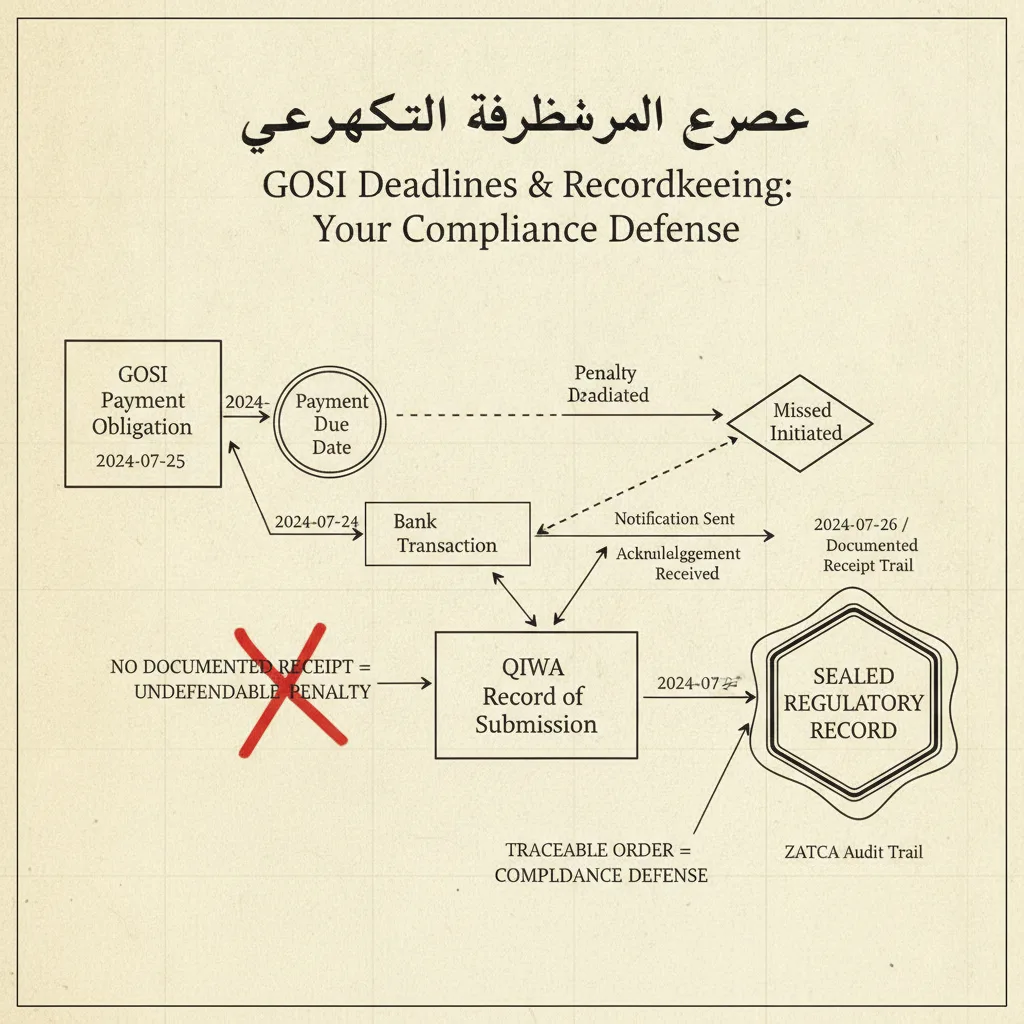
Your payroll team submitted the General Organization for Social Insurance (GOSI) contribution three days late. The payment clears, the portal accepts it, and you assume the matter is closed. Then an audit notice arrives — and the auditor asks for the submission confirmation reference from the month in question. There isn't one. That absence is the problem, not the three-day delay.
Two Obligations, Not One
Employers registered with GOSI carry a payment obligation and a notification obligation. These are not the same thing, and conflating them is the first recordkeeping failure.[1]
The payment obligation is straightforward: monthly contributions must be submitted and settled by the prescribed deadline for the wages of that month's covered employees.[2] Most compliance teams understand this half of the equation well.
The notification obligation is less intuitive. GOSI requires employers to report changes in employee status — new registrations, terminations, salary amendments — within the periods set under the Social Insurance Law.[3] A company that pays on time but fails to notify GOSI of a wage increase has a clean payment record and a separate, open notification breach. The two run in parallel, and each carries its own penalty track.
What "Contemporaneous Documentation" Actually Means
The phrase sounds bureaucratic, but its operational meaning is precise. Contemporaneous documentation is a record created at or immediately after the time of a regulated act — not reconstructed later, not summarized from memory, not inferred from a bank transfer.
For GOSI, a contemporaneous record of a monthly contribution contains four elements:
- The portal submission reference number — the unique identifier GOSI's system assigns at the point of submission. This is the proof that the filing reached the system, distinct from whether payment was cleared.
- The submission timestamp — date and time, not date alone. When a deadline falls on a specific day, hour-level granularity matters in a dispute.
- The wage figures submitted — the reported earnings per employee for that contribution period, retained in a format that can be reconciled against payroll records without reconstruction.
- A record of any subsequent amendments — if a filing was corrected after submission, the record must show when the correction was made, what changed, and who authorized it.
None of these require custom software. They require discipline — saving portal confirmation screens, archiving submission exports, and logging amendments in a shared register the day they occur.
The Four Recordkeeping Failures That Aggravate a Breach
A technical breach — a late submission, an underpaid month — is a calculable penalty. An aggravated breach, by contrast, is one where the employer cannot demonstrate what happened, when it happened, or that any corrective action was voluntary. The following four failures are the most common conversion points.
1. Missing submission timestamps. The GOSI portal records when a filing was submitted. If the employer does not preserve that timestamp independently, and the portal's own session logs are unavailable at audit time, there is no way to prove the filing predated a given deadline. A bank debit date proves payment; it does not prove when the contribution filing was lodged.
2. Absent portal confirmation references. Payment clearing through the employer's bank and GOSI registering a completed contribution are related but distinct events. Employers who retain bank debit records but discard portal confirmation numbers have half a record. During an assessment, the auditor who asks for the contribution reference and receives a bank statement is not satisfied — and is entitled not to be.
3. Unlinked wage-change records. When a salary is amended, the new figure affects the contribution base from the effective date of the change. If the payroll amendment record and the GOSI notification are stored in separate systems with no linking reference, the employer cannot easily demonstrate that the reported contribution base was accurate at the time of each filing. This creates an apparent discrepancy that, absent explanation, looks like underreporting.
4. No audit trail for late corrections. If a filing error is discovered and corrected — a common and entirely legitimate event — the correction record must show that it was initiated by the employer, not triggered by an inspector. A correction with a documented initiation date prior to any GOSI contact is treated differently from an identical correction that appears only after a notice is received. Without the trail, the employer cannot make that distinction.
The Penalty Calculation Difference
GOSI's penalty framework distinguishes between late payment and non-compliance. A late payment with a complete documentation trail is, functionally, a math problem: the penalty applies to the days of delay, the base is the contribution amount, and the employer pays and closes the matter.[2]
Without documentation, the period of non-compliance becomes contestable. The auditor cannot determine from employer records alone when the contribution was actually filed, whether the wage base was accurate, or whether any corrections preceded the audit. Each of those uncertainties expands the potential penalty exposure — not because the employer intended harm, but because the records do not foreclose the worst interpretation.
This is the core argument of this piece: documentation does not reduce the probability of a breach; it limits the consequences of one.
What a Compliant Archive Looks Like
A compliant GOSI recordkeeping archive for a single contribution period is not large. It contains:
- The GOSI portal contribution summary export (typically a PDF or downloadable report) showing each employee's name, identification number, reported wage, and contribution amount.
- The portal submission confirmation, including reference number and timestamp.
- The bank confirmation of settlement, cross-referenced to the portal submission.
- Any wage amendment notifications filed during the period, with GOSI acknowledgment references.
- Any corrective amendments filed after initial submission, with the date of employer-initiated correction and the reason.
This archive should be retained for the period required by Saudi labor and insurance law — at minimum long enough to cover the full potential audit lookback window.[3] Access should be restricted to authorized personnel, and the archive should be searchable by contribution period.
Makyn's View
The compliance failure we see most often in organizations that have not systematized GOSI documentation is not malicious non-compliance — it is the assumption that paying is enough. Payment is necessary; it is not sufficient. The notification side of the obligation, and the documentation of both sides, are where exposure accumulates silently.
What makes this recoverable — and this is the important point — is that GOSI's own systems generate most of the documentation employers need. The portal issues reference numbers. Submissions produce exportable confirmations. The information exists; the gap is almost always in how it is captured, stored, and linked to the corresponding payroll and amendment records.
An automated notice-management system that reads GOSI portal outputs, extracts reference numbers and timestamps, and routes them into a structured compliance archive closes that gap without adding headcount. It also creates the linked record between a wage change, the GOSI notification, and the contribution period — the connection that makes an auditor's question answerable in minutes rather than hours.
If your organization is reviewing its compliance documentation posture, اطلب عرضاً توضيحياً to see how MAKYN structures GOSI archive workflows for mid-size and enterprise employers in Saudi Arabia.
Frequently asked
- What is the monthly contribution deadline for GOSI in Saudi Arabia?
- GOSI requires employers to submit and pay monthly contributions by the end of each month for the current month's covered wages. Employers must also notify GOSI of any changes to employee status — new hires, terminations, or wage amendments — within the periods prescribed under the Social Insurance Law. Missing either action triggers separate penalty tracks.
- What records must an employer keep to defend a late GOSI payment?
- At minimum: the GOSI portal submission reference number, the exact timestamp of each submission, the wage figures reported for each employee, any confirmation receipts issued by the portal, and a written record of any post-submission amendments including the reason for the change. These form the contemporaneous audit trail that distinguishes an honest delay from willful non-compliance.
- What are the four recordkeeping failures that aggravate a GOSI breach?
- First, missing submission timestamps that prevent proving when a filing occurred. Second, absent portal confirmation references, leaving no proof the filing was received. Third, unlinked wage-change records that contradict the reported contribution base. Fourth, no documented audit trail for late corrections — without it, the employer cannot demonstrate the correction was voluntary rather than compelled by an inspection.
- Can GOSI penalties be contested without documentation?
- Practically, no. GOSI's enforcement process places the evidentiary burden on the employer to demonstrate compliance or a good-faith attempt to correct. Without a submission reference, a timestamp, and a complete wage record, the employer has no factual basis to dispute the assessed arrears period or challenge the penalty calculation. Documentation is not a procedural nicety — it is the defense itself.
Sources
- 1. General Organization for Social Insurance — www.gosi.gov.sa
- 2. General Organization for Social Insurance — www.gosi.gov.sa
- 3. General Organization for Social Insurance — www.gosi.gov.sa