Audit Trails for Regulatory Notices: What Saudi Law Requires
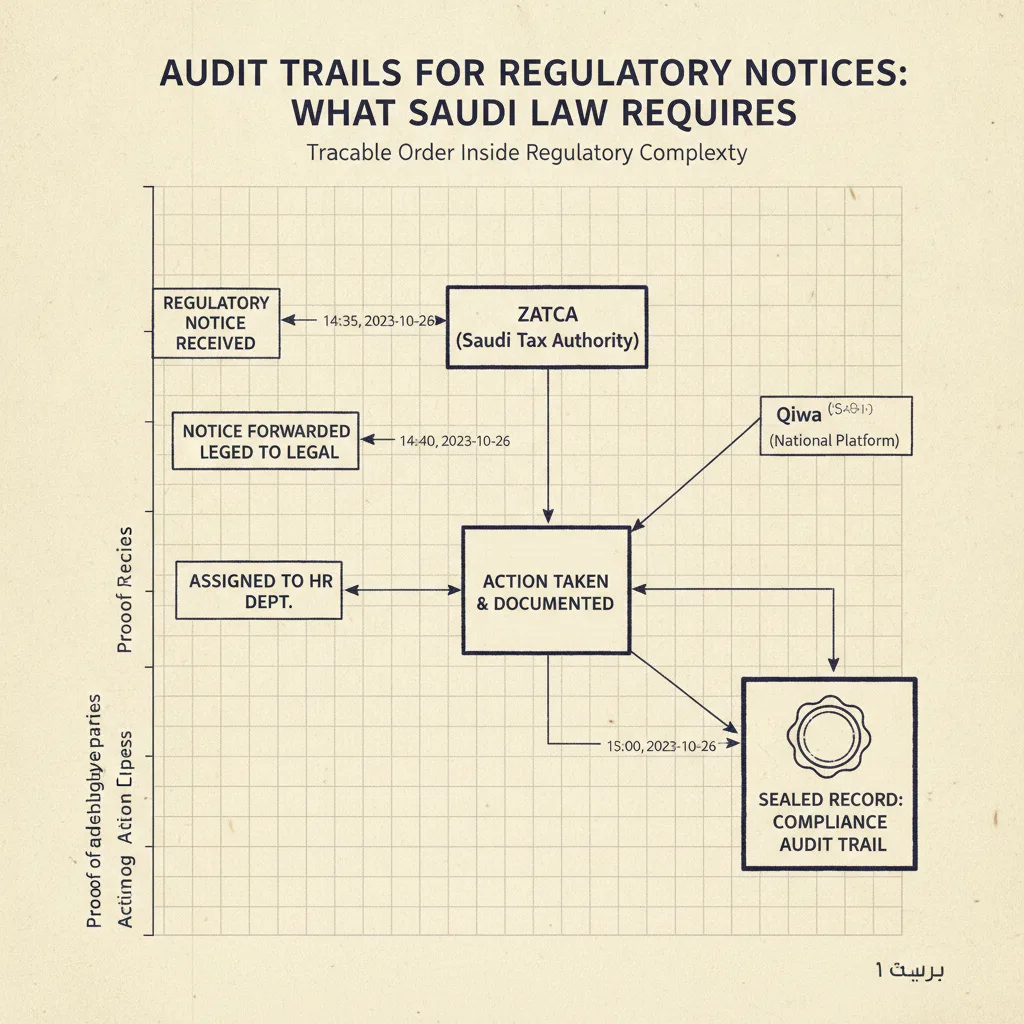
A ZATCA field auditor arrives with a list of VAT notices sent to your firm over the past three years. She wants to know: who received each one, who was assigned to act, and what happened within the response window. Your team opens Outlook and begins searching. That moment — the frantic inbox search — is the compliance failure, regardless of what the search eventually finds.
Saudi regulators do not publish a mandatory file format for regulatory notice records. What they do, consistently, is ask three questions that an email thread cannot reliably answer.
The Three Questions Every Saudi Regulator Will Ask
Across the Zakat, Tax and Customs Authority (ZATCA), the General Organisation for Social Insurance (GOSI), and the inquiry practice of the Ministry of Commerce and related Ministerial bodies, the evidentiary expectation converges on the same three facts:
- When was the notice received? Not when it was sent by the regulator — when it entered your firm's awareness and control, with a verifiable, unalterable timestamp.
- Who was responsible for acting on it? A named individual or an identified role, not a shared inbox alias that four people may or may not have monitored.
- What was done, and by when? A documented action trail: acknowledgement, internal assignment, resolution, and any filing or payment that followed.
These three facts are not stated as a single rule in any one regulation. They are the implied evidentiary standard that emerges when you read ZATCA's record-keeping framework [2], the Financial Oversight Law that entered into force on 11 April 2026 [3], and the SAMA-aligned archiving obligations that govern entities with Saudi Central Bank exposure [1] together. The pattern is the requirement.
What ZATCA's Record-Keeping Framework Actually Demands
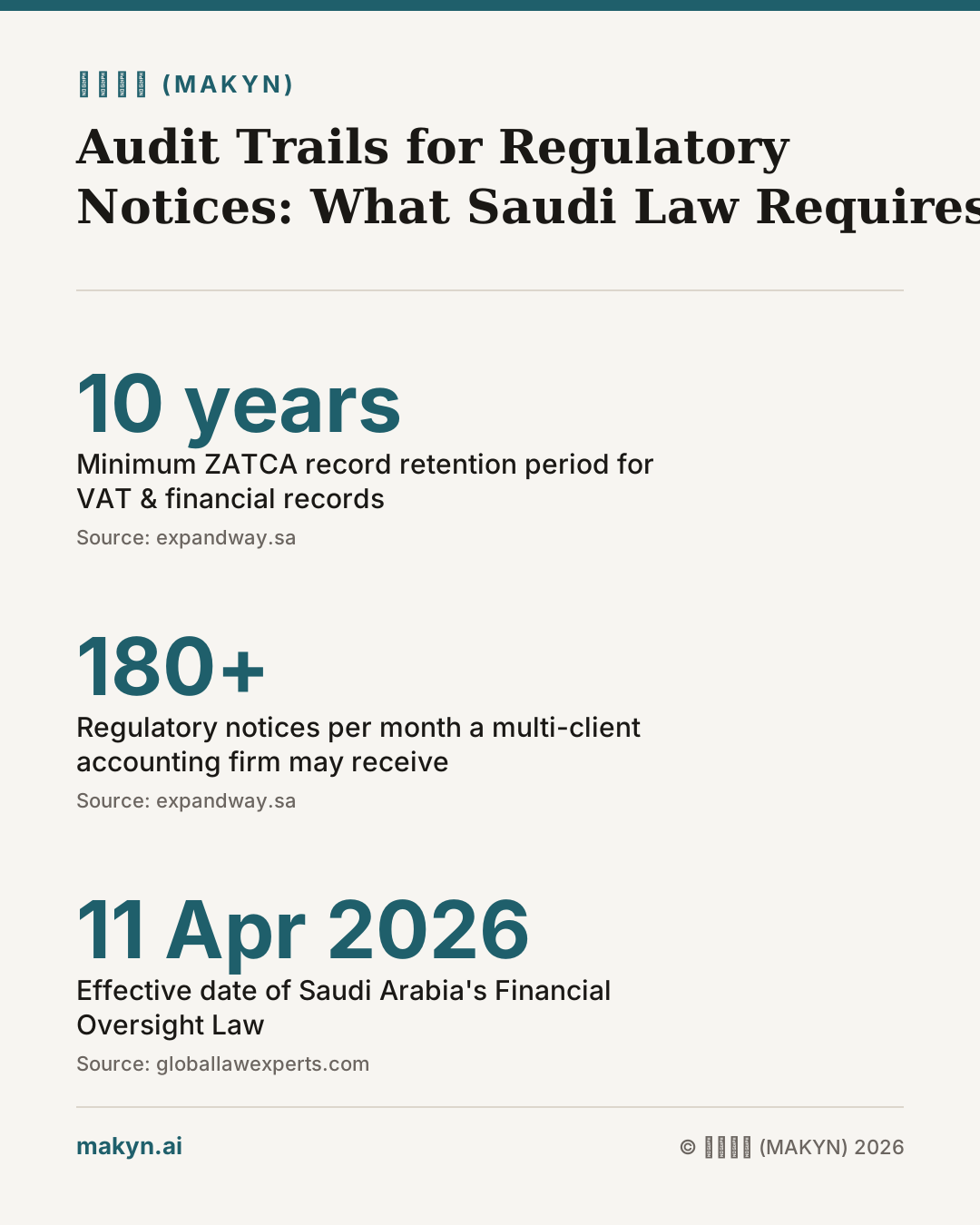
ZATCA requires businesses registered for VAT and e-invoicing to maintain accurate financial records, invoices, contracts, and payment documents — with a minimum retention period of 10 years [2]. The obligation extends explicitly to VAT correspondence and supporting agreements, not just the invoices themselves.
Three practical requirements follow from this:
- Immutability: A record that can be edited after the fact is not a record in any regulatory sense. ZATCA's framework assumes that what was stored is what occurred [2].
- Invoice traceability: The authority expects to be able to trace any document back through its lifecycle — creation, transmission, receipt acknowledgement, and storage — without gaps [2].
- Internal compliance review cadence: Businesses are expected to conduct regular reviews to confirm their records remain complete and retrievable, not merely stored [2].
An email thread fails on all three counts. It is editable, it breaks traceability at the point of human forwarding, and no one reviews whether the relevant thread still exists in a departing employee's personal folder.
For accounting firms managing notices across multiple client entities, the problem multiplies. A firm receiving 180 or more regulatory notices per month across a client portfolio cannot reconstruct evidentiary chains from inbox searches after the fact. The architecture must capture the chain at intake.
The Financial Oversight Law: A Harder Standard for Working Papers
Saudi Arabia's Financial Oversight Law, published in the Official Gazette and effective 11 April 2026, introduced a broader scope than the previous General Auditing Bureau framework [3]. Ministerial Decision No. 929/1447 supplements the law with implementing regulations, and secondary operational rules were expected to be finalised by August 2026 [3].
For the purposes of regulatory notice recordkeeping, the law's most significant implication is its extension of working-paper retention obligations. Where the previous framework focused primarily on financial statement audit files, the new law's scope reaches the documentary record of how an entity responded to regulatory events — which includes notices from ZATCA, GOSI, and Ministerial inquiries [3].
CFOs and audit partners now face a dual obligation: the ZATCA 10-year floor on tax records, and a separate working-paper regime that governs the procedural record of how compliance was managed. These are not the same archive. A firm that conflates them risks satisfying one obligation while inadvertently voiding the other.
Why Format Neutrality Is Not the Same as Architecture Neutrality
No Saudi regulation specifies PDF, XML, or any other format as the required container for a regulatory notice record. This is sometimes read as permissiveness — "we can store it however we like." That reading is wrong in practice.
Format neutrality means the regulator does not care whether the record is a scanned PDF or a structured database entry. It does not mean the regulator will accept an unstructured, unsearchable, role-anonymous pile of files as a valid audit trail. The three evidentiary questions — receipt timestamp, named responsible party, documented action — impose implicit structural requirements that any compliant archive must satisfy, regardless of the underlying format.
The minimum architecture that satisfies those requirements has four components:
- Intake log: A system-generated, immutable record of when a notice entered the firm's infrastructure, distinguishable from when the human operator first viewed it.
- Assignment record: A timestamped link between the notice and a named individual or role, created at the moment of assignment, not reconstructed afterward.
- Action log: A sequential, append-only record of every step taken on the notice — acknowledgements, filings, escalations, and closures.
- Retention index: A searchable index that allows any notice to be retrieved by regulator, entity, date range, and responsible party within the recall period — which for ZATCA purposes extends to 10 years [2].
None of these components require a specific file format. All of them require deliberate system design.
GOSI and the Contribution Deadline Chain
GOSI's compliance obligations create a recurring, deadline-driven notice stream. Contribution deadlines, penalty notices, and Saudization quota alerts arrive on regular cycles, and each carries its own response window. The evidentiary standard GOSI applies when investigating a late or missed contribution is functionally identical to ZATCA's: prove that the notice was received, assigned, and acted on — or accept that the failure was yours.
The recordkeeping challenge with GOSI notices is that they are often operationally routine until they are not. A firm that handles 50 contribution cycles without incident may find that one missed assignment — one notice that sat in a shared inbox over a public holiday — becomes the anchor of a penalty dispute. Without an intake log and assignment record, there is no counter-evidence.
MAKYN's approach to GOSI notice management is detailed in GOSI Contribution Deadlines and the Recordkeeping Standard That Protects You, which maps the deadline cycle to the specific record types each stage requires.
Ministerial Inquiries: The Least Predictable Category
Inquiries from the Ministry of Commerce and related Ministerial bodies are less predictable in timing and format than ZATCA or GOSI notices, but no less demanding in their evidentiary expectations. A Ministerial inquiry may arrive as a formal letter, a platform notification, or a direct request channelled through the firm's registered agent. Whatever the delivery mechanism, the response expectation is the same: demonstrate a coherent, documented record of the matter in question.
The absence of a systematic intake log for Ministerial correspondence is among the most common sources of preventable compliance exposure in Saudi-registered firms. The inquiry arrives; the relevant person is on leave; no one knows whether the notice was formally received or who was last handling the underlying matter. That scenario is not an IT problem — it is a recordkeeping architecture problem.
MAKYN's View: Build the Architecture Before the Auditor Arrives
The firms that manage regulatory notice audits without crisis are not the ones with better lawyers. They are the ones whose systems captured the three evidentiary facts automatically, at intake, without relying on any individual to remember to document their actions.
MAKYN reads, extracts, and routes regulatory notices from ZATCA, GOSI, and Ministerial sources into a structured intake log the moment they are received. Every notice receives a timestamp, a named assignment, and an append-only action trail — independent of whether the responsible team member is in the office, in a meeting, or on leave. The archive is indexed by regulator, entity, date, and actor, and it holds records across the full 10-year retention horizon required by ZATCA [2].
This is not a document management product. It is the evidentiary layer that sits between the regulator's notice and the firm's response, making the three questions answerable before they are asked.
Firms evaluating whether their current setup meets this standard will find the structural criteria set out in Evaluating Saudi Compliance Management Software: A Buying Framework a useful reference. For firms whose notice volume already warrants a dedicated tracking architecture, How Accounting Firms Should Track ZATCA Notifications Systematically provides the operational model.
The regulatory standard is already in place. The architecture question is whether your systems meet it today or whether you discover the gap during an active audit. اطلب عرضاً توضيحياً to assess where your current recordkeeping stands against the implied evidentiary requirements of ZATCA, GOSI, and Ministerial inquiry practice.
Frequently asked
- How long must businesses in Saudi Arabia retain regulatory notice records?
- ZATCA mandates a minimum 10-year retention period for VAT invoices, contracts, and supporting financial documents. Saudi Arabia's Financial Oversight Law, which took effect on 11 April 2026, extends working-paper retention obligations further. Best practice is to align all regulatory correspondence to the 10-year floor and apply immutable storage from the date of receipt.
- What three facts must an audit trail for a regulatory notice prove?
- Regulators across ZATCA, GOSI, and Ministerial inquiries consistently expect firms to establish: (1) when the notice was received, with a verifiable timestamp; (2) which named individual or role was responsible for acting on it; and (3) what specific action was taken and when. These three facts define the implied evidentiary standard even though no regulation specifies a file format.
- Why is email insufficient as an audit trail for regulatory notices?
- Email threads can be deleted, forwarded out of sequence, or left unread without any system-level record of the failure. They cannot guarantee immutability, cannot reliably attribute accountability to a named role, and cannot support sub-24-hour retrieval under active audit pressure. An auditor asking for proof of receipt and response will not accept a searched inbox as an answer.
- Does Saudi law specify a required file format for regulatory notice records?
- No Saudi regulation prescribes a specific format — not ZATCA's implementing rules, not the Financial Oversight Law, and not GOSI's contribution compliance framework. What they share is an outcome requirement: the firm must be able to produce a coherent, timestamped, role-attributed record of notice receipt and resolution on demand during an audit or inquiry.
Sources
- 1. SAMA Compliance: Long-Term Record Archiving for Saudi Arabian Banks — www.archondatastore.com
- 2. ZATCA Record Keeping Requirements in Saudi Arabia 2026 Guide — expandway.sa
- 3. Financial Oversight Law Saudi Arabia | Global Law Experts — globallawexperts.com