E-Invoicing Saudi Arabia: What AI Must Get Right
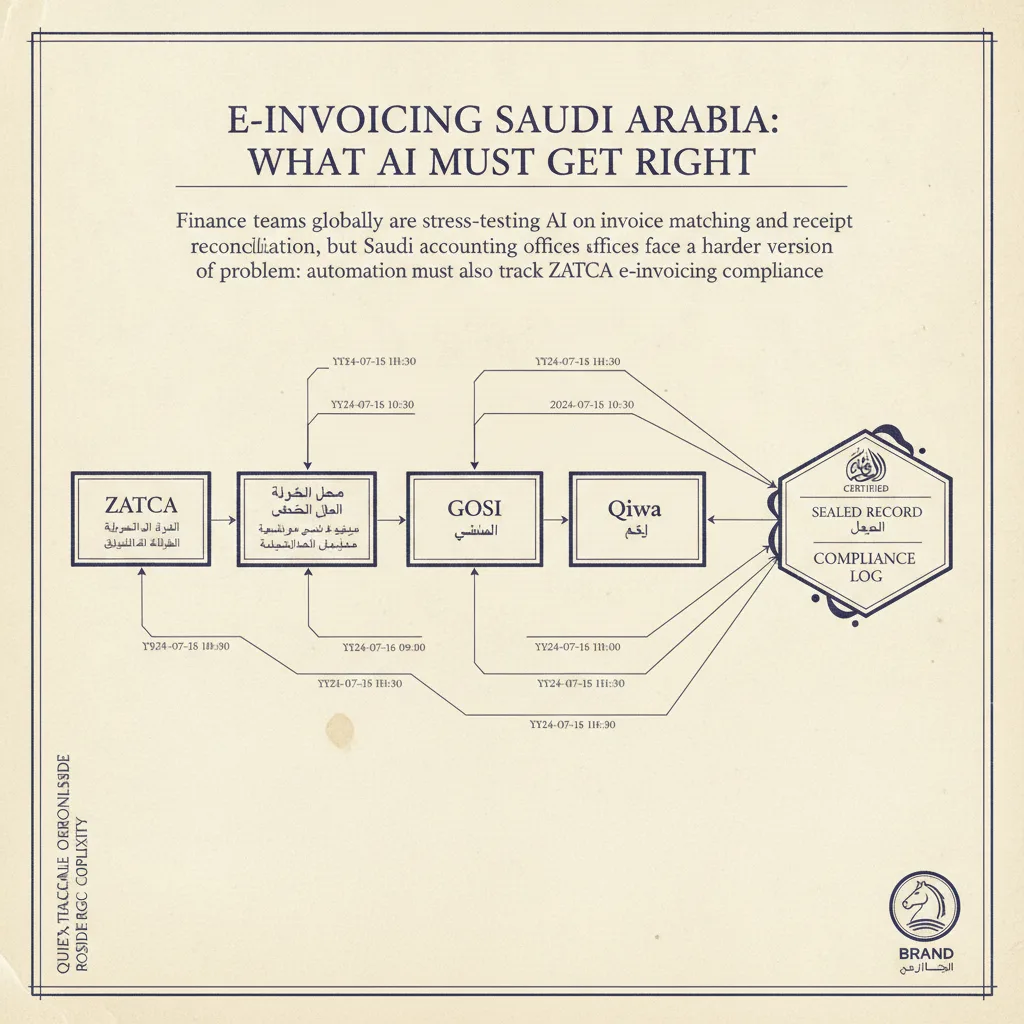
A Saudi accounting office handling a mid-size portfolio receives, on any given week, a ZATCA clearance rejection, a General Organization for Social Insurance (GOSI) contribution notice, and a Qiwa platform update on a client's Saudization ratio — all in Arabic, all carrying deadlines, all requiring a documented response. The question is not whether to automate this. The question is what must be in place before automation can be trusted.
What Finance Teams Are Actually Trying to Automate — and Where It Breaks
The case for AI in finance operations is structurally sound. Machine learning applied to accounts payable and receivable, payroll processing, and transaction reconciliation reduces manual processing time and the error rate that comes with high-volume repetitive work. Saudi CFOs are tracking this shift closely, with Vision 2030's digital transformation mandate accelerating the timeline [1].
But the workloads Saudi accounting teams most urgently want to eliminate — chasing regulatory portals for new notices, logging ZATCA responses before deadlines expire, assembling evidence packages for periodic reviews — are not the workloads most AI finance tools are designed to handle. They are designed for structured transaction data: line items, amounts, account codes. Regulatory notice management is a different problem entirely. It involves unstructured Arabic text, agency-specific document formats, and action obligations that carry legal weight.
The break point is predictable: an automation layer that handles invoices efficiently but has no mechanism for ingesting a ZATCA portal notice will process transactions cleanly right up until an inspection reveals that three clearance rejections were never formally acknowledged. At that point, the efficiency gain is irrelevant.
Why Saudi Compliance Workflows Are a Harder Automation Problem
Three factors make the Saudi context structurally more demanding than the generic finance-automation use case.
Arabic as the authoritative language. Regulatory notices from ZATCA, GOSI, and Qiwa are issued in Arabic. For compliance purposes, the Arabic document is the source of truth. Any system that extracts English-translated summaries and discards the original Arabic document cannot produce a defensible audit trail. This is not a translation problem; it is a legal-record problem.
Multi-body regulatory feeds. A Saudi accounting firm tracking compliance for multiple clients must monitor at minimum three regulatory bodies simultaneously — the Zakat, Tax and Customs Authority (ZATCA) for e-invoicing and tax matters, GOSI for social insurance contributions, and Qiwa for labor compliance and Saudization obligations. Each body has its own portal, its own notice format, and its own deadline logic. No single global compliance tool has production-ready integrations with all three.
Audit-trail obligations with long recall windows. ZATCA inspections can reach back across multiple filing periods. A compliant audit trail must show not just what was filed, but what notices were received, when they were seen by a responsible party, and what action was taken. See the full breakdown of what Saudi law actually requires in Audit Trails for Regulatory Notices: What Saudi Law Actually Requires.
The Five Tasks AI Can Reliably Handle Today — and Where It Still Fails
Assessing AI finance tools honestly means separating categories where reliability is established from categories where it is not.
Reliably handled today:
- Invoice data extraction from structured formats. Optical character recognition combined with large language models can extract vendor name, amount, VAT registration number, and line items from well-formed invoices with high accuracy — provided the document format is consistent.
- Three-way matching on structured purchase orders. Matching invoice amounts against purchase orders and goods receipts is a solved problem when all three documents are in a consistent digital format.
- Anomaly flagging in transaction streams. AI systems can flag statistical outliers in payment patterns — duplicate amounts, unusual vendor frequencies, round-number clusters — for human review [1].
- Payroll calculation for defined rule sets. Where GOSI contribution rates and Saudization thresholds are encoded as rules, AI can apply them consistently to payroll data [1].
- Deadline calendar generation from structured inputs. Given a client's VAT registration date and filing frequency, a system can generate a compliance calendar automatically.
Where AI still fails:
- Interpreting ambiguous Arabic regulatory language. A ZATCA notice that references a specific article of the e-invoicing regulation and requires a response within a defined period requires human judgment to classify correctly. AI extraction of deadline dates from free-form Arabic legal text remains unreliable enough that automated action on the extracted date without human confirmation is a compliance risk.
- Detecting a missing notice. AI can process notices it receives. It cannot reliably detect that a notice it should have received never arrived — a critical gap when portal delivery is inconsistent.
- Generating compliant ZATCA e-invoice XML. Producing a ZATCA-compliant UBL XML invoice with the correct cryptographic hash, UUID, and clearance stamp requires integration with ZATCA's Fatoora API. This is an engineering integration problem, not an AI problem — but tools marketed as "AI invoice automation" frequently conflate the two.
For a detailed view of what ZATCA-accredited software actually requires accounting offices to implement, see What Software Accreditation Really Means for ZATCA Compliance.
Audit-Trail Requirements Under ZATCA: What Any Automation Must Preserve
ZATCA's Phase 2 e-invoicing framework requires that every tax invoice be cleared through the Fatoora platform in near-real time, cryptographically stamped, and stored in a format that makes tampering evident. This is not a records recommendation; it is a technical mandate with penalty exposure for non-compliance.
For accounting firms managing client portfolios, the audit-trail obligation extends beyond the invoice itself. It includes:
- The original Arabic notice or rejection from ZATCA, unmodified.
- A timestamped record confirming when the notice was received and by which staff member or system.
- Documentation of the corrective action taken and the date it was completed.
- Linkage between the notice, the corrected invoice, and the relevant VAT filing period.
An automation system that stores only extracted fields — rejection code, invoice number, amount — and discards the source document fails this standard. During a ZATCA inspection, the inspector will ask to see the original notice. "Our system extracted the key data" is not an acceptable response.
The same logic applies to GOSI contribution discrepancies and Qiwa compliance alerts. For the contribution deadline and recordkeeping specifics that govern GOSI obligations, see GOSI Contribution Deadlines and the Recordkeeping Standard That Protects You. For a practical view of what a monitoring dashboard must surface, see What a Qiwa–GOSI Compliance Dashboard Must Show an Accountant.
The audit-trail requirement is not a feature to add later. It is the precondition for everything else.
The Sequence Problem: Why Most Firms Get This Backwards
The typical adoption pattern is: acquire an AI finance tool, connect it to accounting data, discover compliance gaps when a notice is missed or a ZATCA rejection goes unresolved, then attempt to retrofit an audit trail. This sequence is common because automation tools are marketed on efficiency metrics — invoices processed per hour, reconciliation time saved — and compliance infrastructure is invisible until it fails.
The correct sequence inverts this. Before any automated transaction processing is trusted:
- Establish a verified regulatory feed — a system that reliably ingests notices from ZATCA, GOSI, and Qiwa portals, timestamps each notice at receipt, and routes it to a responsible party with a recorded deadline.
- Build the audit-trail layer — every notice stored in its original Arabic form, every action logged with timestamp and actor.
- Then automate transactions — with the compliance context already in place, automation decisions (auto-approve an invoice, auto-generate a remittance) can be made against a backdrop of known regulatory status.
Firms managing multiple clients face an amplified version of this problem. A missed ZATCA notice for Client A can be obscured by the volume of activity across Clients B through F. The structural challenges of multi-client compliance management are addressed in Managing Multi-Client Compliance in Saudi Arabia Without Delegation Failure.
MAKYN's View: Build the Compliance Feed First, Automate Second
The Saudi market is not short of AI finance tools. It is short of AI tools that treat Arabic regulatory documents as the primary input rather than a secondary parsing challenge, and that understand audit-trail obligations as a design constraint rather than a reporting feature.
The argument for building compliance infrastructure before automation is not a conservative argument against technology. It is a structural argument about sequencing. An accounting office that automates invoice matching before establishing a verified ZATCA notice feed has optimized the wrong bottleneck. The bottleneck that carries penalty exposure is regulatory notice management — knowing what arrived, when it arrived, what it required, and that it was handled. Invoice matching efficiency is valuable only when it sits on top of that foundation.
This is precisely where MAKYN operates. The platform reads Arabic regulatory notices from ZATCA, GOSI, and Qiwa, extracts action obligations and deadlines, routes them to the correct responsible party, and stores the original document alongside every action taken — before any automation layer touches a transaction. The result is an audit trail that exists because the system was designed around it, not because someone remembered to build one after the fact.
For firms evaluating what a compliance management platform must actually demonstrate before purchase, the framework in Evaluating Saudi Compliance Management Software: A Buying Framework provides a structured set of questions. For teams concerned about data sovereignty when using AI tools — a legitimate concern given documented incidents in the broader market — When AI Leaks Your Compliance Data: Lessons from the Claude Incident is required reading before any vendor is shortlisted.
Automation in Saudi finance is not a question of whether. It is a question of in what order. The compliance feed comes first. Everything else follows.
اطلب عرضاً توضيحياً لمعرفة كيف تبني ماكن طبقة الامتثال قبل أي أتمتة.
Frequently asked
- What does ZATCA Phase 2 e-invoicing actually require from Saudi businesses?
- ZATCA Phase 2 mandates that businesses integrate their billing systems with ZATCA's Fatoora platform for real-time or near-real-time invoice clearance, apply cryptographic stamps to every tax invoice, and retain compliant records accessible for audit. The rollout is wave-based, with each wave defined by annual revenue thresholds. Non-compliance exposes businesses to penalties and potential suspension of VAT registration.
- Why do generic AI finance automation tools fall short in Saudi Arabia?
- Most global AI finance tools are designed around English-language documents and Western regulatory structures. They lack native handling of Arabic text as a source of truth, have no built-in feeds for ZATCA, GOSI, or Qiwa regulatory notices, and do not produce the specific audit-trail formats that Saudi inspections require. Plugging them into a Saudi compliance workflow creates gaps that only appear during an audit.
- What is the correct order: build automation first or build the compliance layer first?
- The compliance and audit-trail layer must come first. Automation that runs without a verified regulatory feed can process transactions efficiently while accumulating compliance exposure invisibly. Once a ZATCA inspection or GOSI audit is triggered, an automation-first firm has no reliable record of what notices were received, when they were acted on, or what the original Arabic document stated.
- What must an audit trail for ZATCA regulatory notices actually contain?
- At minimum: the original Arabic document in its unmodified form, a timestamped record of when it was received and by whom, a log of every action taken in response, and linkage to the relevant transaction or filing period. ZATCA inspectors may request evidence spanning up to several years. A trail that only stores extracted data fields — not the source document — does not meet this standard.
Sources
- 1. AI & Automation in Finance: What It Means for Saudi CFOs | Grant Thornton — www.grantthornton.sa